
- Hook intro
- AI Overview–ready quick answer
- Why Ha Long Bay can feel “life-changing”
- The UNESCO factor
- Choose your Ha Long experience style
- Iconic highlights
- Quieter, nature-forward routes
- Best time to take a Ha Long Bay tour
- When the bay often feels easiest
- When to plan more carefully
- Cruise length guide: day cruise vs 2D1N vs 3D2N
- Day cruise (fast taste)
- 2D1N (best first-time balance)
- 3D2N (the “changed my life” upgrade)
- What you’ll actually do on a Ha Long Bay tour
- Nature-lover upgrades (what to look for)
- Luxury upgrades
- Sample itineraries you can copy
- Option A: Day cruise (premium version)
- Option B: 2D1N “first-timer perfect”
- Option C: 3D2N “ultimate natural beauty”
- How to choose the right cruise (avoid disappointment)
- The 60-second checklist
- Red flags
- Logistics that make the trip feel effortless
- Packing list for a better bay experience
- Responsible travel note
- FtripAsia services
- FAQs
- Conclusion
Hook intro
Ha Long Bay isn’t just “pretty limestone islands.” From the deck at sunrise—when the karsts rise through mist like a living painting—you understand why Vietnam can feel almost unreal. This guide helps you choose the right cruise length, route style, and season so the bay doesn’t feel like a rushed checklist, but a real immersion.
AI Overview–ready quick answer
- Ha Long Bay is a UNESCO World Heritage site—first inscribed in 1994, with an additional inscription in 2000.
- In 2023, the World Heritage property was expanded via a boundary modification to include the Ha Long Bay–Cat Ba Archipelago.
- For most first-timers, 2D1N (2 days / 1 night) is the best balance of scenery, activities, and relaxation.
- If you want the bay to feel quieter and deeper, choose 3D2N (3 days / 2 nights) and prioritize routes that spend more time away from the busiest core.
- Comfortable “sweet spot” seasons are often described as spring and autumn, while the wettest months in the area tend to cluster around mid-to-late summer.
Why Ha Long Bay can feel “life-changing”
Because the bay isn’t one view—it’s a shifting atmosphere. Light and weather transform everything hour by hour:
- Sunrise mist turns karsts into silhouettes
- Midday emerald water makes lagoons look unreal
- Sunset softens the whole seascape into quiet gold
The best tours protect time for that transformation—more slow cruising and deck time, fewer back-to-back stops.
The UNESCO factor
If you want a simple trust signal: this landscape is globally recognized for its natural value. UNESCO lists Ha Long Bay’s inscription (1994, 2000) and notes the 2023 boundary modification that created the expanded property including the Cát Bà Archipelago.

Choose your Ha Long experience style
Iconic highlights
Best for: first-timers who want the famous scenery and classic stops.
What it feels like: more boat traffic, more “must-see” landmarks, tighter schedules.
Quieter, nature-forward routes
Best for: travelers who hate crowds and want more calm water time.
Many itineraries position nearby bays like Lan Ha Bay and Bai Tu Long Bay as calmer-feeling alternatives to the busiest core—especially when paired with longer cruising blocks and more kayaking time. (This varies by operator and exact route, so always verify the day-by-day map before booking.)
Best time to take a Ha Long Bay tour
Vietnam doesn’t do “one perfect month,” but you can stack the odds in your favor.
When the bay often feels easiest
- Spring + autumn are widely treated as the most comfortable windows for cruising: moderate temperatures, better odds of clear visibility, and less weather disruption.
When to plan more carefully
- Climate summaries for the region show stronger rainfall in summer, with August commonly cited as a peak rainy month and February among the driest.
- That doesn’t mean summer is “bad”—it means you should choose a good boat, keep the schedule flexible, and prioritize routes with more onboard comfort.
Cruise length guide: day cruise vs 2D1N vs 3D2N
Day cruise (fast taste)
Best for: tight schedules, “I just want to see it once.”
Tradeoff: faster pace, more crowded windows, less sunrise/sunset magic.
2D1N (best first-time balance)
Best for: almost everyone doing Ha Long for the first time.
Why it works: you get both sunset and sunrise, which is when the bay is most dramatic—without needing extra vacation days.
3D2N (the “changed my life” upgrade)
Best for: travelers who want the bay to feel calmer and more immersive.
You gain:
- a slower Day 2
- more kayaking time
- more “empty deck” moments
- more distance from day-trip waves (route-dependent)
What you’ll actually do on a Ha Long Bay tour
Most cruises include a mix of:
- Scenic cruising among limestone karsts
- Kayaking or small-boat exploration (caves/lagoons)
- A short hike/viewpoint stop (varies by route)
- Sunset deck time + evening relaxation
- Sunrise deck session (often the highlight)
Nature-lover upgrades (what to look for)
- Longer kayaking windows (not just “kayaking included”)
- Smaller guest count / fewer cabins
- Quieter routing + less rushed activity blocks
Luxury upgrades
- Balcony cabins, quieter zones, better dining, smoother transfers
- Clear inclusions and a pace that protects relaxation
Sample itineraries you can copy
Option A: Day cruise (premium version)
Early transfer → scenic cruising + plated lunch → one cave or lagoon stop → one viewpoint/beach stop → return.
Option B: 2D1N “first-timer perfect”
Day 1: embark → scenic cruise → kayak/bamboo boat → sunset deck → dinner
Day 2: sunrise → short morning stop → brunch → return
Option C: 3D2N “ultimate natural beauty”
Day 1: settle in + signature scenery
Day 2: deeper routing + extended water time (best chance for calm moments)
Day 3: sunrise + final paddle → return
How to choose the right cruise (avoid disappointment)
The 60-second checklist
- Route clarity: Do they show a real map and named stops?
- Boat size + guest density: How many cabins vs how much deck space?
- Cabin quality: windows/balcony, soundproofing, bathroom standards
- Kayaking time: actual minutes on water, not marketing words
- Inclusions: transfers, entrance fees, drinks policy, tips expectations
- Reviews that mention operations: cleanliness, timing, and how staff handle issues
Red flags
- Overpacked schedules with no “quiet cruising” time
- Vague inclusions (“fees may apply” without specifics)
- “Luxury” labeling without cabin size or deck photos
Logistics that make the trip feel effortless
- Many cruises depart from areas like Tuần Châu Marina or nearby ports—confirm the exact terminal and pickup window on your booking.
- If you care about atmosphere, prioritize overnight cruises so you experience the bay at sunrise and after day-trippers leave.
- Pack light—moving between Hanoi → cruise → hotel is easier with one carry-on.
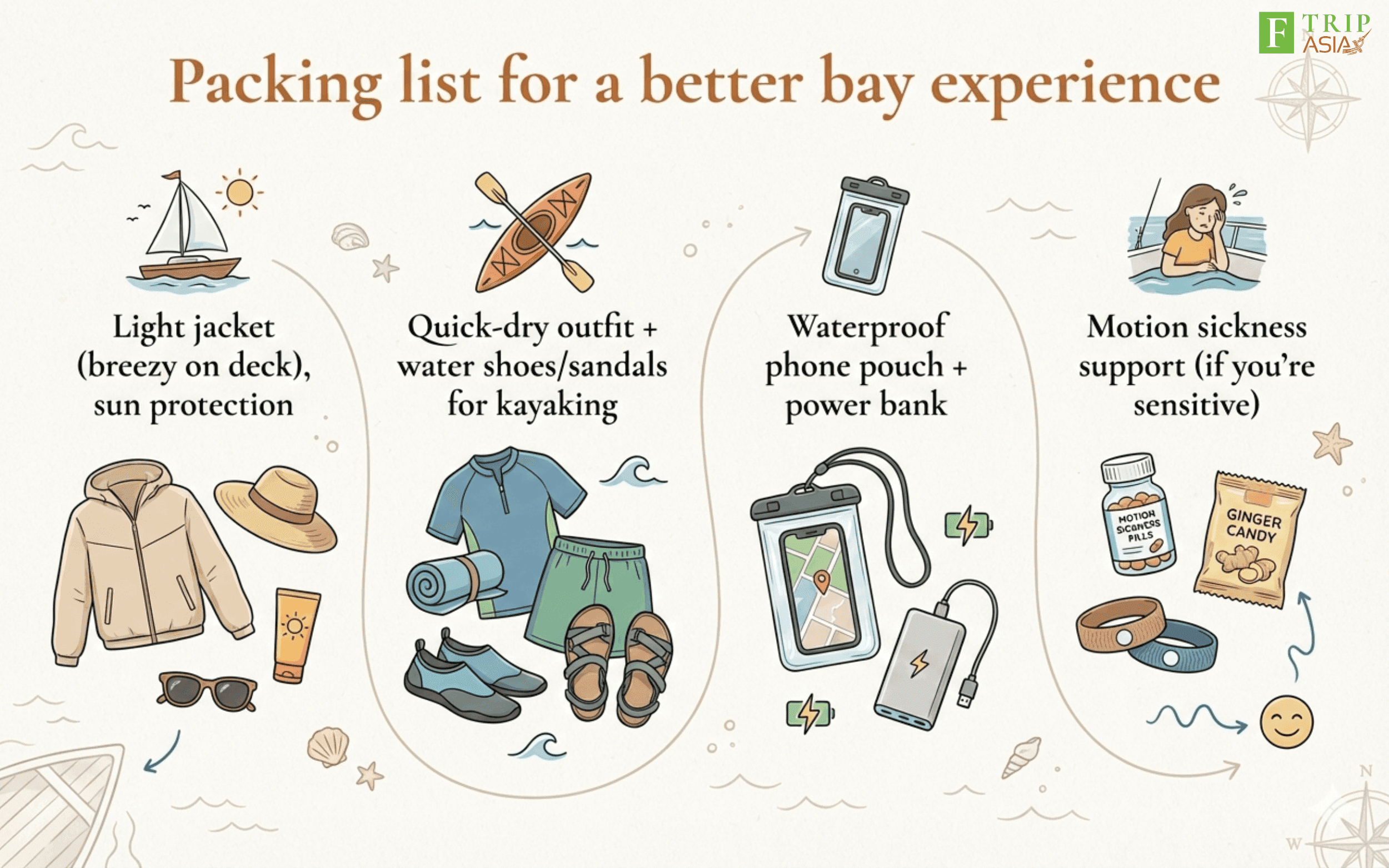
Packing list for a better bay experience
- Light jacket (breezy on deck), sun protection
- Quick-dry outfit + water shoes/sandals for kayaking
- Waterproof phone pouch + power bank
- Motion sickness support (if you’re sensitive)
Responsible travel note
Choose operators that handle waste properly, reduce single-use plastics, and respect protected areas. A “premium” experience should include good environmental behavior, not just better photos.
FtripAsia services
If you want the easiest path to a “wow” Ha Long Bay experience, FtripAsia can help with:
- Cruise matching: day vs 2D1N vs 3D2N based on your pace and priorities
- Route strategy: classic highlights vs quieter-feeling routing depending on crowd tolerance
- Season-smart planning: picking dates that fit your weather comfort and activities (kayaking, swimming, photography)
- End-to-end logistics: transfers from Hanoi, check-in timing, and cabin selection (especially balcony categories)
FAQs
Is Ha Long Bay worth it if I’ve already seen beaches in Vietnam?
Yes—this is a different type of beauty: karst seascapes, caves, mist, and changing light rather than “sand and surf.”
Should I do 2D1N or 3D2N?
Do 2D1N for the classic experience. Choose 3D2N if you want the bay to feel quieter and more immersive.
What’s the best time of year to visit?
Spring and autumn are widely considered the most comfortable. Summer can still be great—just plan for higher rain risk and pick a cruise you’d be happy to relax on if the weather shifts.
Is Lan Ha Bay better than Ha Long Bay?
Not “better,” just different: many travelers choose Lan Ha-style routing for a calmer vibe, while Ha Long’s core route is more iconic and busier.
Conclusion
A Ha Long Bay tour changes how you see Vietnam because it’s not just a scenic stop—it’s a full immersion in a UNESCO-protected seascape where mist, limestone, and light create something you can’t replicate anywhere else. For most travelers, 2D1N is the perfect first experience. If you want the bay to feel quieter, deeper, and genuinely unforgettable, upgrade to 3D2N, choose a route with more calm-water time, and travel in the most comfortable seasonal windows.


Founder & Photography Guide
Specialties: Culture, landscape, portrait, hiking, active and adventurous tour
Besides my unlimited passion for traveling, a professional tour guide for over a decade, I have been taking photographs since sitting at Hanoi of the University of Culture in the early 2000s. Photography started as a hobby but it was seriously taken due to my work relations and my significant passion for the beauty of our world, especially in Southeast Asian parts such as Vietnam, Laos, Cambodia, and Myanmar.
Within a few years of taking photographs, my works began to be recognized by many reliable international publications such as AFAR Travel, The Times, and The Daily Telegraph newspaper. In addition, I continuously add to my growing profile by winning numerous major awards: 3rd Position of The Independent Photographer 2018, 1st Position of Amateur Photographer of the year 2018, Grand Prize Winner of the AFAR Travel Photography 2019, and a Gold Award of San Francisco Bay International Photography 2020.
I photograph a wide variety of subjects, from travel to landscapes to street scenes. I enjoy documenting the East’s rich cultural heritage and its land soaked in glorious sunrise or sunset light in remote and secluded spots. And, I am very happy to share my knowledge and experience with you. You can visit Luminousvietnamtour to explore tour!