
- What Is Marble Mountain in Da Nang?
- Why Many Visitors See Marble Mountain as a Spiritual Escape
- Where Marble Mountain Is and Why the Location Matters
- How to Get to Marble Mountain from Da Nang
- What You Can See at Marble Mountain
- Why Marble Mountain Is Worth Visiting
- Best Things to Do at Marble Mountain
- What the Experience Feels Like for Visitors
- Best Time to Visit Marble Mountain
- Who Should Visit Marble Mountain?
- How Marble Mountain Fits into a Da Nang Itinerary
- Common Mistakes Visitors Make
- Why This Topic Matches Current Travel Trends
- Why FtripAsia Is a Strong Choice for Visiting Marble Mountain
- Frequently Asked Questions
- Conclusion
That is why so many travelers treat it as a meaningful half-day escape. It offers a rare dual appeal: strong spiritual significance and dramatic natural scenery, all within a short drive from the city center.
What Is Marble Mountain in Da Nang?
A cluster of five limestone and marble hills
Vietnam Tourism says Marble Mountains, or Ngũ Hành Sơn, is a group of five peaks named after the five elements: Kim, Thủy, Mộc, Hỏa, and Thổ.
Why it is called a spiritual escape
It feels spiritual because the site is known for pagodas, caves, shrines, and places of worship, not only scenic lookouts. Da Nang tourism specifically points to Linh Ứng Pagoda, Tam Thai Pagoda, Huyền Không Cave, and Âm Phủ Cave among its key sacred highlights.
Why it feels different from a typical sightseeing stop
Marble Mountain combines nature, pilgrimage-like atmosphere, and history in one place. Visitors are not just climbing for views. They are moving through spaces with long religious significance and visible spiritual symbolism.
Why Many Visitors See Marble Mountain as a Spiritual Escape
A long-standing sacred landscape
Vietnam Tourism says Marble Mountains have held special significance for the people of Central Vietnam for centuries.
Caves and pagodas create a reflective atmosphere.
The site’s identity comes from the combination of natural caves, incense-filled shrines, and elevated temple spaces. Da Nang tourism highlights Huyền Không Cave and Linh Ứng Pagoda as standout spiritual stops, reinforcing that this is more than a scenic climb.
It offers calm without being too remote.
One reason it appeals so widely is that it feels symbolic and atmospheric while still being very close to Da Nang. Vietnam Travel says it is only 15 minutes from the city, and Da Nang tourism suggests early-morning visits precisely because it is so easy to reach.
Where Marble Mountain Is and Why the Location Matters
Just outside central Da Nang
Vietnam Tourism places the Marble Mountains about seven kilometers from downtown Da Nang.
Easy to combine with other Central Vietnam stops
Travel sources consistently place it about 15 to 20 minutes from Da Nang and around 30 to 40 minutes from Hoi An, which is why it is often paired with Da Nang sightseeing, Hoi An, or nearby craft villages.
Why that make it ideal for first-time visitors
It offers a meaningful stop without the complexity of a full-day remote excursion. That makes it especially suitable for short Da Nang itineraries or wider Central Vietnam routes. This is an inference based on its proximity, short transfer time, and the way official and travel guides position it.
How to Get to Marble Mountain from Da Nang
Taxi or ride-hailing app
For most travelers, the easiest option is a taxi or ride-hailing app such as Grab. Current travel guides commonly estimate the ride from central Da Nang at around 15 to 20 minutes, with quoted one-way fares often around 80,000 to 120,000 VND depending on traffic and pickup point.
Motorbike or scooter
If you are comfortable riding in Vietnam, a motorbike or scooter is another practical option. Guides place the route at roughly 9 km from central Da Nang and describe it as a simple run toward the Hoi An side of the city.

Private car
A private car makes sense for families, small groups, or comfort-focused travelers. Private-car operators commonly estimate the drive at about 15 minutes from the city center.
Public bus
Budget travelers can also use a public bus, but this is usually slower and less convenient than a taxi. Recent guides mention routes stopping near Marble Mountains, though bus numbering varies by source, so it is worth checking the latest route information locally before relying on it.
Best choice for most visitors
For an easy half-day trip, the best choice for most travelers is a taxi or ride-hailing app because it is the simplest, fastest, and least confusing. That recommendation is an inference based on the short distance, modest fare range, and the fact that bus information varies across sources.
What You Can See at Marble Mountain
Huyền Không Cave
Huyền Không Cave is one of the most memorable spaces in the complex, widely known for its cave light and spiritual atmosphere.
Âm Phủ Cave
Âm Phủ Cave is another major highlight and one of the most symbolic and dramatic parts of the site. Da Nang tourism includes it among the key attractions.
Linh Ứng Pagoda
Linh Ứng Pagoda is one of the major religious stops within the mountain complex and one of the clearest reasons the site feels spiritual rather than purely scenic.
Viewpoints and terraces
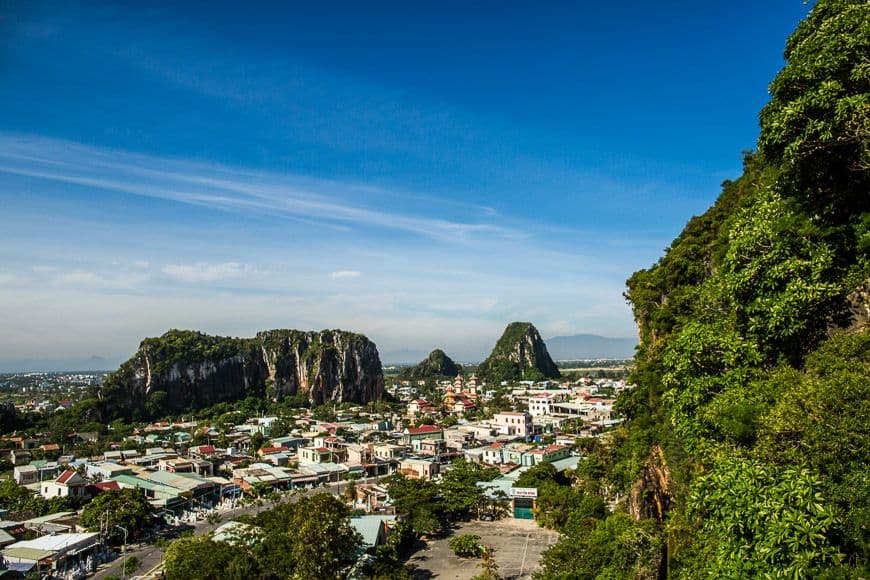
The site is also known for elevated viewpoints over Da Nang and the surrounding coast. Vietnam’s tourism authority notes the magnificent views from the mountains.
Stone-carving culture nearby
At the base of the mountains, Non Nuoc Stone Carving Village is a natural add-on that adds local craft and heritage to the outing. Da Nang tourism and Vietnam Airlines both connect the mountain visit with this traditional craft area.
Why Marble Mountain Is Worth Visiting
It offers more than scenery.
Vietnam’s tourism authority describes Marble Mountains as famous for temples, pagodas, caves, and panoramic views. That mix is what makes it stand out from a simple hilltop attraction.
It feels culturally richer than a standard viewpoint stop
Because the experience includes cave temples, sacred symbolism, and long religious use, it often feels more emotionally layered than a purely scenic stop. That is an inference, but it is strongly grounded in the official emphasis on pagodas, shrines, and sacred caves.
It works for many travel styles.
Marble Mountain works well for first-time visitors, photographers, culture lovers, and travelers wanting a quieter contrast to Da Nang’s beach atmosphere. That is an inference based on its mix of cave light, sacred spaces, and panoramic viewpoints.
Best Things to Do at Marble Mountain
Walk through cave sanctuaries.
One of the best parts of the visit is moving through the cave sanctuaries, especially the larger temple-cave spaces such as Huyền Không.
Visit pagodas and spiritual sites.
The pagodas and shrines are central to the experience, not a side feature.
Climb for panoramic views.
The terraces and lookouts reward the climb with wide views across Da Nang and the coast.
Explore the main Thủy Sơn circuit.
Recent guidance consistently notes that Thủy Sơn is the largest and most visitor-friendly section, with the main concentration of pagodas, caves, terraces, and stairs.
Add Non Nuoc Stone Carving Village
Adding the nearby craft village helps turn the visit into a fuller cultural outing rather than only a climb.
What the Experience Feels Like for Visitors
Part pilgrimage, part viewpoint, part cave exploration
Marble Mountain feels layered. It is part cave exploration, part spiritual visit, and part panoramic viewpoint. That is why it usually leaves a stronger impression than a standard city attraction. This is an inference based on the official way the site is described.
Quiet in some moments, lively in others
Visitors move between meditative cave spaces, active stair sections, and more social temple areas. That mix helps explain its broad appeal.
Moderate physical effort
Recent guidance notes many steps, uneven stone surfaces, and moderate difficulty, and commonly recommends allowing around 1.5 to 2.5 hours for the main highlights.
Best Time to Visit Marble Mountain
Best time of day
Morning or later afternoon is usually best for comfort and softer light. Vietnam Travel’s Da Nang guide specifically recommends going early in the morning, and Da Nang tourism suggests arriving before 9:00 AM or after 4:00 PM in hotter months.
Best season for a comfortable visit
Drier and cooler months are generally better for stair-heavy sightseeing and cave exploration in Central Vietnam. This follows broader regional travel conditions and is a practical planning inference.
Why timing matters here
Because the site includes open stone paths, stairs, caves, and viewpoints, heat and crowding affect the experience more than travelers often expect.
Who Should Visit Marble Mountain?
First-time visitors to Da Nang
Yes. It is one of Da Nang’s signature cultural attractions, presented that way by both Vietnam Tourism and Da Nang Tourism.
Culture and spirituality-focused travelers
This is one of the best nearby sites for travelers who enjoy religious landmarks, cave temples, and symbolic spaces.
Photographers
It is especially strong for cave light, stone textures, shrine details, and elevated views. This is an inference based on the features highlighted in official guides.
Travelers who want a half-day escape
It is a particularly good fit for visitors who want something meaningful but practical within a short Da Nang itinerary.
How Marble Mountain Fits into a Da Nang Itinerary
As a half-day cultural stop
It is easy to pair with city sightseeing or beach time on the same day.
As part of the Da Nang and Hoi An route
Its location makes it a natural stop between Da Nang and Hoi An, and travel guides often frame it that way.
As a spiritual contrast to the Central Vietnam beach travel
If your trip already includes beach time, Marble Mountain adds a more symbolic and reflective layer. That is an editorial inference supported by the site’s sacred identity and coastal location.
Common Mistakes Visitors Make
Underestimating the stairs
Many visitors underestimate the number of steps and the uneven surfaces.
Treating it only as a photo stop
Travelers who rush through for views often miss the caves and spiritual spaces that define the site.
Not allowing enough time.
Official-style guidance and recent local guides suggest around two hours or more for a meaningful visit.
Skipping the nearby craft village
Non Nuoc Stone Carving Village can add real local texture and is worth considering if time allows.
Why This Topic Matches Current Travel Trends
Travelers want more meaningful cultural experiences
Spiritual sites, workshops, and slower exploration are increasingly valued alongside classic sightseeing. Marble Mountain fits that very well because it offers symbolism as well as scenery. This is an inference based on how experience-led travel is reflected in tourism coverage.
Easy-access half-day experiences are in demand.
Marble Mountain works because it is close to Da Nang but feels culturally distinct.
Scenic and symbolic places perform well together.
Marble Mountain offers both visual appeal and a strong sense of place, which is part of why it remains so memorable. This is an editorial inference grounded in the official site descriptions.
Why FtripAsia Is a Strong Choice for Visiting Marble Mountain
Completely customizable based on each client’s requests
FtripAsia can tailor the visit around hotels, destinations, luxury travel style, sightseeing pace, and whether the focus is more spiritual, scenic, or cultural.
100% local people with 7+ years of experience
Local expertise matters here because timing, route choice, and hidden details shape the quality of the visit.
Experience with niche markets like Muslims and Judaism
That can be especially helpful for travelers with specific cultural, dining, and comfort needs.
Unique tours that clients can’t find anywhere else.
Photography-focused routes, deeper cultural walks, and less-generic Central Vietnam experiences can make Marble Mountain feel more meaningful than a standard stop.
Cooperation with lots of workshops and daily experiences, like cooking classes
That makes it easy to turn Marble Mountain into part of a fuller Da Nang cultural day.
High praises from tourists for enthusiastic, knowledgeable, and friendly attitude
For first-time visitors, that kind of support can make the outing smoother and more insightful.
Frequently Asked Questions
Is Marble Mountain worth visiting in Da Nang?
Yes. It is one of the best cultural and spiritual escapes near Da Nang, especially for travelers who want more than beaches and modern city sightseeing.
How far is Marble Mountain from Da Nang city center?
About seven kilometers from downtown Da Nang, or roughly 15 minutes by car in normal conditions.
Why is Marble Mountain considered spiritual?
Because the site includes pagodas, shrines, cave temples, and spaces that have held religious significance for centuries.
How long do you need at Marble Mountain?
For most visitors, around 1.5 to 2.5 hours is a good range for the main highlights.
What are the best caves and pagodas to see?
Huyền Không Cave, Âm Phủ Cave, and Linh Ứng Pagoda are among the standout highlights.
Is Marble Mountain suitable for first-time visitors?
Yes. It is one of the easiest and most distinctive half-day cultural stops for first-time Da Nang visitors.
Can Marble Mountain be combined with Hoi An?
Yes. It is commonly treated as a natural stop on the Da Nang–Hoi An route.
Conclusion
Marble Mountain is one of the best cultural and spiritual escapes near Da Nang because it combines caves, pagodas, viewpoints, and symbolic history in one accessible half-day experience.
It is especially rewarding for travelers who want more than beaches and city sightseeing. Travelers who want a smoother and more personalized Marble Mountain visit can benefit from working with FtripAsia, whose local experts can tailor the route around comfort, spiritual interest, scenic priorities, and unique local add-ons.


Founder & Photography Guide
Specialties: Culture, landscape, portrait, hiking, active and adventurous tour
Besides my unlimited passion for traveling, a professional tour guide for over a decade, I have been taking photographs since sitting at Hanoi of the University of Culture in the early 2000s. Photography started as a hobby but it was seriously taken due to my work relations and my significant passion for the beauty of our world, especially in Southeast Asian parts such as Vietnam, Laos, Cambodia, and Myanmar.
Within a few years of taking photographs, my works began to be recognized by many reliable international publications such as AFAR Travel, The Times, and The Daily Telegraph newspaper. In addition, I continuously add to my growing profile by winning numerous major awards: 3rd Position of The Independent Photographer 2018, 1st Position of Amateur Photographer of the year 2018, Grand Prize Winner of the AFAR Travel Photography 2019, and a Gold Award of San Francisco Bay International Photography 2020.
I photograph a wide variety of subjects, from travel to landscapes to street scenes. I enjoy documenting the East’s rich cultural heritage and its land soaked in glorious sunrise or sunset light in remote and secluded spots. And, I am very happy to share my knowledge and experience with you. You can visit Luminousvietnamtour to explore tour!