
- Is It Easy to Travel from Sapa to Ninh Binh?
- Why the route can feel confusing at first
- Why this guide matters for first-time visitors
- Where Are Sapa and Ninh Binh in a Northern Vietnam Itinerary?
- What Sapa is known for
- What Ninh Binh is known for
- Why travelers often combine them
- Best Ways to Travel from Sapa to Ninh Binh
- Sleeper bus from Sapa to Ninh Binh
- Train plus transfer
- Private car from Sapa to Ninh Binh
- Why is there no simple flight option
- Which Transport Option Is Best for First-Time Visitors?
- Best for simplicity
- Best for comfort
- Best for budget travelers
- Best for travelers who enjoy the journey itself
- Sapa to Ninh Binh Travel Time Explained
- Why this is not a quick hop
- What affects total travel time
- Why first-time visitors should build in buffer time
- Direct Route vs Going Through Hanoi
- When a direct route makes more sense
- When going through Hanoi is smarter
- Which option is better for beginners
- Common Mistakes First-Time Visitors Make on This Route
- Underestimating travel fatigue
- Choosing the cheapest option without checking comfort
- Planning too much for the arrival day
- Forgetting that Sapa and Lao Cai are not the same station point
- What First-Time Visitors Should Pack and Prepare for the Journey
- Travel essentials for moving between Sapa and Ninh Binh
- Comfort tips for overnight travel
- Booking and timing tips
- Best Order for a Northern Vietnam Route: Sapa First or Ninh Binh First?
- Why do many travelers visit Sapa first?
- Why can Ninh Binh also work first
- Which order is best for first-time visitors
- How Many Days Should You Spend in Sapa and Ninh Binh?
- Ideal time in Sapa
- Ideal time in Ninh Binh
- Ideal total route length
- Suggested Itinerary Ideas for First-Time Visitors
- 4-day fast route
- 5 to 6-day balanced route
- 7-day northern Vietnam route
- More comfortable version with Hanoi stop
- Best Things to Do in Ninh Binh After Arriving from Sapa
- Take a Trang An or Tam Coc boat trip
- Climb Hang Mua for panoramic views
- Visit temples and countryside areas
- Slow down and enjoy the contrast after mountain travel
- Who Should Choose Each Travel Style?
- Sleeper bus
- Train plus transfer
- Private car
- Why FtripsAsia Is a Strong Choice for Planning Sapa to Ninh Binh Travel
- Completely customizable based on each client’s requests
- 100% local people with 7+ years of experience
- Experience with niche markets like Muslims and Judaism
- Unique tours that clients cannot find anywhere else
- Cooperation with lots of workshops and daily experiences like cooking classes
- High praise from tourists for enthusiastic, knowledgeable, and friendly attitude
- Frequently Asked Questions
- Is there a direct bus from Sapa to Ninh Binh?
- Can I take a train from Sapa to Ninh Binh?
- Do I need to go through Hanoi?
- How long does it take to travel from Sapa to Ninh Binh?
- Is this route suitable for first-time visitors to Vietnam?
- Should I visit Sapa or Ninh Binh first?
- What is the most comfortable way to travel between them?
- Conclusion
For most travelers, the real priority is not finding the most complicated “technical” route. It is finding the easiest option, understanding realistic travel time, and choosing the most comfortable way to move with luggage and limited energy. That is especially important on this route, because Sapa is known for trekking, mountain views, and ethnic-culture travel, while Ninh Binh is better suited to slower sightseeing such as boat rides, viewpoints, and temple visits.
This guide breaks the journey down simply so first-time visitors can choose the right transport style with more confidence.
Is It Easy to Travel from Sapa to Ninh Binh?
Yes, it is very doable, but it is not as simple as traveling between two major cities with a single obvious rail or flight connection. In practice, travelers usually choose between direct road transport and a more structured rail-based route that passes through Lao Cai and often Hanoi.
Why the route can feel confusing at first
The main reason this route feels confusing is that Sapa itself is not a railway city. Official Vietnam tourism guidance notes that rail travelers usually take the night train from Hanoi to Lao Cai, then continue by road for about an hour to reach Sapa town. That means anyone trying to use trains for Sapa to Ninh Binh is not boarding directly in Sapa.
Why this guide matters for first-time visitors
For first-time visitors, the biggest concerns are usually avoiding too many transfers, handling luggage easily, and choosing between daytime and overnight travel. On this route, those practical factors often matter just as much as the ticket price. This is an inference based on the structure of the route and the transport options available.

Where Are Sapa and Ninh Binh in a Northern Vietnam Itinerary?
What Sapa is known for
Sapa is one of northern Vietnam’s best-known mountain destinations, with rice terraces, trekking, ethnic communities, and a cooler highland atmosphere. Vietnam’s official tourism site presents it as a place for sustainable travel, mountain scenery, and local cultural discovery.
What Ninh Binh is known for
Ninh Binh is known for Trang An and Tam Coc boat rides, Hang Mua viewpoint, limestone landscapes, and nature-and-culture travel close to Hanoi. Official tourism guidance highlights sampan tours, Hang Mua’s panoramic views, and the area’s wider landscape appeal.
Why travelers often combine them
Travelers often combine these two places because they show very different sides of northern Vietnam. Sapa offers mountain adventure and ethnic-culture trekking, while Ninh Binh offers softer scenic travel with river landscapes, temples, and slower-paced sightseeing. Together, they create a more complete northern Vietnam route. This is an inference grounded in the official destination profiles of both places.
Best Ways to Travel from Sapa to Ninh Binh
Sleeper bus from Sapa to Ninh Binh
A sleeper bus is often one of the simplest and most direct options. Current route listings show direct buses operating between Sapa and Ninh Binh, with total travel times commonly in the 7 to 12 hour range and bus-specific estimates around 7 hours 20 minutes on some services.
This option is usually best for travelers who want fewer transfers and do not mind overnight or longer road transport. It is especially attractive for budget-conscious travelers, backpackers, and visitors who prefer direct movement over extra logistics. The traveler-type guidance here is an inference based on the nature of direct sleeper-bus travel.
Train plus transfer
The classic rail-based route is not direct. It usually works like this: Sapa to Lao Cai by road, Lao Cai to Hanoi by train, then Hanoi to Ninh Binh by train or private road transfer. Official tourism guidance confirms that Sapa is accessed by road from Lao Cai and that the Hanoi–Lao Cai night train takes about eight hours.
This option is less direct, but some travelers find it more structured and easier to understand once broken into segments. It is a stronger fit for people who like rail travel, want to break up the journey, or may prefer an overnight train plus a separate next-day move to Ninh Binh. That preference-based guidance is an inference.
Private car from Sapa to Ninh Binh
A private car is usually the most comfortable and flexible option because it removes most of the transfer complexity. Current overland listings also show taxi or private road options on this route alongside bus services.
This is often the best choice for families, couples, small groups, photographers, or travelers with more luggage. It costs more, but it can make the day feel much smoother by simplifying pickup, drop-off, and stop timing. The comfort advantage is an inference based on the door-to-door nature of private transport.
Why is there no simple flight option
There is no simple flight option because Sapa does not have an airport. In practical terms, that leaves road and rail combinations as the main realistic choices for this route. Official tourism guidance on reaching Sapa focuses on limo vans and the Hanoi–Lao Cai train rather than air access.
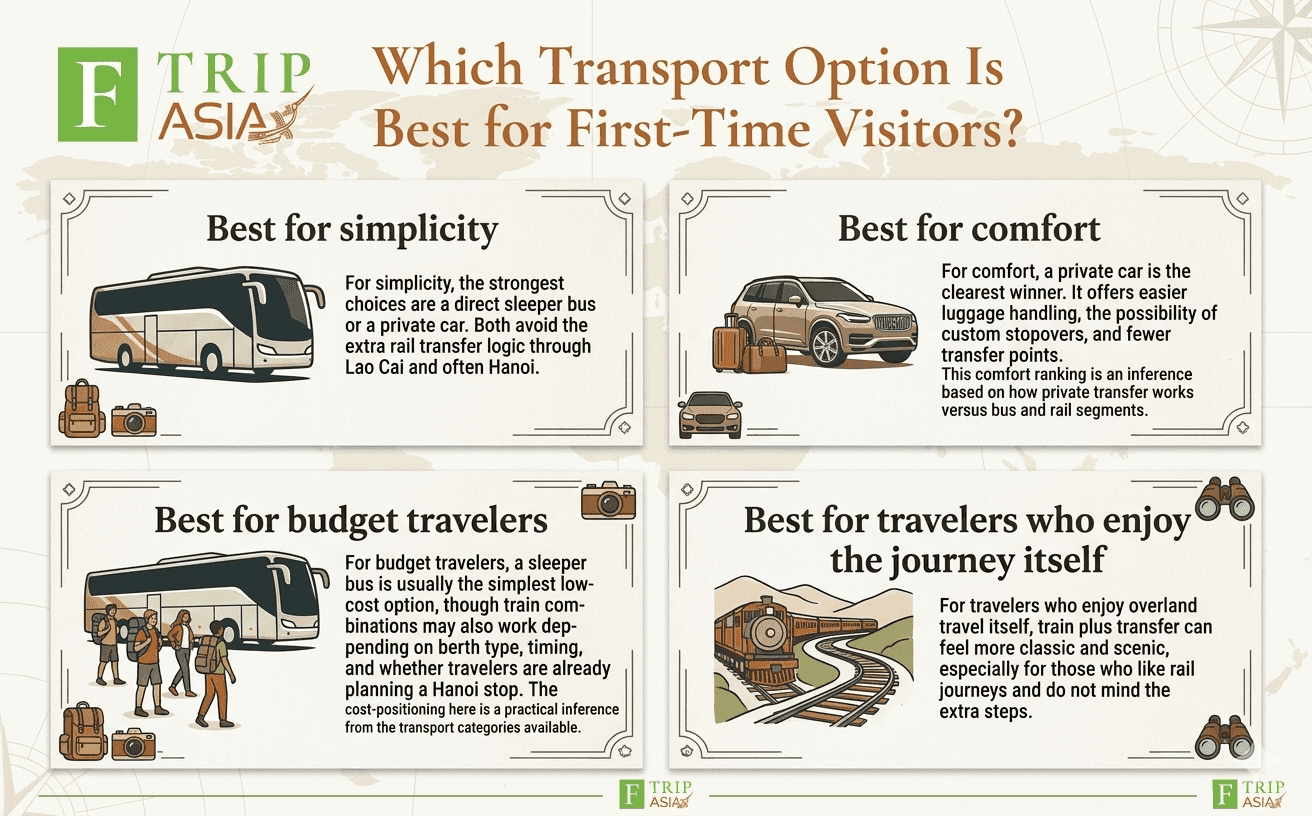
Which Transport Option Is Best for First-Time Visitors?
Best for simplicity
For simplicity, the strongest choices are a direct sleeper bus or a private car. Both avoid the extra rail transfer logic through Lao Cai and often Hanoi.
Best for comfort
For comfort, a private car is the clearest winner. It offers easier luggage handling, the possibility of custom stopovers, and fewer transfer points. This comfort ranking is an inference based on how private transfer works versus bus and rail segments.
Best for budget travelers
For budget travelers, a sleeper bus is usually the simplest low-cost option, though train combinations may also work depending on berth type, timing, and whether travelers are already planning a Hanoi stop. The cost-positioning here is a practical inference from the transport categories available.
Best for travelers who enjoy the journey itself
For travelers who enjoy overland travel itself, train plus transfer can feel more classic and scenic, especially for those who like rail journeys and do not mind the extra steps.
Sapa to Ninh Binh Travel Time Explained
Why this is not a quick hop
This is not a quick hop because the route is long and connects mountain roads with lowland transport corridors. Current route listings place the overland distance at about 313 kilometers, while other travel sources sometimes estimate closer to 410 kilometers depending on endpoint assumptions and route mapping. Either way, it is a substantial journey that requires planning.
What affects total travel time
Total travel time depends on the transport type, whether the route is direct or indirect, traffic, mountain road conditions, and whether you depart overnight or during the day. Current route pages estimate the overall trip at roughly 7 to 12 hours, which shows how much schedules can vary.
Why first-time visitors should build in buffer time
First-time visitors should build in extra buffer time because Sapa is often physically tiring before departure, especially if the trip includes trekking or highland day trips. It is usually smarter not to plan a packed sightseeing schedule immediately after arrival in Ninh Binh. That advice is an inference based on the travel time plus the character of both destinations.
Direct Route vs Going Through Hanoi
When a direct route makes more sense
A direct route makes more sense for travelers who want to save time and avoid breaking the journey into too many pieces. That is why a direct sleeper bus or private car is often the simplest practical answer.
When going through Hanoi is smarter
Going through Hanoi is smarter if you want to break up the trip, prefer trains, or plan to include Hanoi in the itinerary anyway. Since the main classic rail access to Sapa runs through Hanoi and Lao Cai, this routing can feel more comfortable for some travelers even though it is less direct.
Which option is better for beginners
For beginners, direct is usually better for simplicity, while a Hanoi stop is often better for comfort and pacing. The best option depends more on travel style than on a universal rule. That conclusion is an inference based on the strengths of each transport style.
Common Mistakes First-Time Visitors Make on This Route
Underestimating travel fatigue
A common mistake is underestimating how tiring the route can feel after Sapa. Trekking and mountain transfers often leave travelers more tired than expected, and Ninh Binh is better enjoyed when you arrive with enough energy for boat rides, viewpoints, and countryside travel. This is an inference grounded in the official activity profiles of both destinations.
Choosing the cheapest option without checking comfort
Another mistake is choosing the cheapest ticket without thinking about sleep quality, luggage comfort, or transfer stress. Not every traveler rests well on overnight buses or split-segment rail trips. Current user reviews on some bus listings also show that comfort can vary significantly by operator.
Planning too much for the arrival day
It is better to keep the first evening in Ninh Binh light. A boat ride or Hang Mua climb is usually more enjoyable after rest than immediately after a long overland transfer. This is practical advice inferred from the route and Ninh Binh’s activity style.
Forgetting that Sapa and Lao Cai are not the same station point
A very common planning mistake is forgetting that Sapa and Lao Cai are not the same departure point. Rail planning revolves around Lao Cai, not Sapa town itself.
What First-Time Visitors Should Pack and Prepare for the Journey
Travel essentials for moving between Sapa and Ninh Binh
It is smart to pack layers for Sapa’s cooler mountain air and lighter clothing for Ninh Binh’s lower-altitude warmth. A charger, snacks, water, and a small overnight bag also help, especially on sleeper transport. The climate contrast here is an inference based on Sapa’s highland character and Ninh Binh’s lower-lying northern climate.
Comfort tips for overnight travel
For overnight transport, a neck pillow, eye mask, light jacket, and easy-access valuables make the trip more manageable. This is practical travel advice rather than a sourced operational rule.
Booking and timing tips
Always confirm the departure and arrival points carefully, check whether hotel pickup is included, and avoid very tight same-day sightseeing plans. That advice follows directly from the multi-format nature of this route.
Best Order for a Northern Vietnam Route: Sapa First or Ninh Binh First?
Why do many travelers visit Sapa first?
Many travelers do Sapa first because the longer mountain transit and trekking can feel easier earlier in the trip, when energy levels are higher. This is an itinerary inference rather than a fixed rule.
Why can Ninh Binh also work first
Ninh Binh can also work well because it is gentler and easier after Hanoi, especially for travelers easing into Vietnam. Boat rides, viewpoints, and countryside travel can feel like a softer start than heading straight into mountain conditions.
Which order is best for first-time visitors
For first-time visitors, Hanoi → Ninh Binh → Sapa is often better for a gentler progression, while Hanoi → Sapa → Ninh Binh can be better for travelers who want to tackle the most active mountain section first. The better order depends on energy level, season, and the rest of the itinerary. This is an inference based on destination character and transport logic.
How Many Days Should You Spend in Sapa and Ninh Binh?
Ideal time in Sapa
For first-time visitors, 2 to 3 days in Sapa is usually a good range for trekking, viewpoints, and local culture. This is an itinerary recommendation based on Sapa’s standard activity pattern.
Ideal time in Ninh Binh
For Ninh Binh, 2 days is usually enough for a balanced first visit that includes a boat ride, Hang Mua, and one or two temples or countryside stops. That recommendation aligns well with the main official highlights.
Ideal total route length
If you combine Sapa and Ninh Binh with Hanoi comfortably, 5 to 7 days is a strong minimum, with more time needed if you also add Ha Long Bay or slower travel. This is an itinerary inference based on travel time and the number of core experiences involved.
Suggested Itinerary Ideas for First-Time Visitors
4-day fast route
A fast version could be Sapa, an overnight transfer, then Ninh Binh highlights. This works, but it is more tiring and better suited to travelers with limited time.
5 to 6-day balanced route
A more balanced route is 2 days in Sapa, 1 travel day, and 2 days in Ninh Binh. That gives both destinations enough room to feel enjoyable rather than rushed. This is an itinerary inference based on the activity load and transfer time.
7-day northern Vietnam route
For first-time visitors, a 7-day route including Hanoi, Sapa, and Ninh Binh is often the easiest way to create a more complete northern Vietnam experience without overloading each day.
More comfortable version with Hanoi stop
A more comfortable pacing option is Sapa → Hanoi overnight → Ninh Binh. This works especially well for travelers who want to sleep better and reduce travel fatigue. That comfort advantage is an inference based on route structure.
Best Things to Do in Ninh Binh After Arriving from Sapa
Take a Trang An or Tam Coc boat trip
A Trang An or Tam Coc boat trip is one of the best first activities after arriving because it is scenic and relatively low effort. Official tourism guidance describes it as an essential Ninh Binh experience.
Climb Hang Mua for panoramic views
If your energy is good, Hang Mua is one of the strongest panoramic experiences in Ninh Binh, with around 500 steps to the lookout.
Visit temples and countryside areas
Temples and countryside routes are another good way to enjoy the softer side of Ninh Binh after Sapa’s mountain intensity.
Slow down and enjoy the contrast after mountain travel
One of the pleasures of this route is the contrast itself. After Sapa’s cool mountains and trekking, Ninh Binh feels slower, warmer, and more open. That is an experiential inference based on the official profiles of both destinations.

Who Should Choose Each Travel Style?
Sleeper bus
Sleeper bus is best for budget travelers, backpackers, and travelers with limited time who want the simplest direct route.
Train plus transfer
Train plus transfer suits rail lovers, travelers who enjoy classic overland journeys, and those comfortable with extra transitions.
Private car
A private car is strongest for couples, families, luxury travelers, photographers, and anyone wanting the smoothest overall experience. That recommendation is an inference based on the flexibility of private transport.
Why FtripsAsia Is a Strong Choice for Planning Sapa to Ninh Binh Travel
Completely customizable based on each client’s requests
FtripsAsia can tailor hotels, destinations, private transfers, sightseeing pace, comfort level, and luxury add-ons around the route.
100% local people with 7+ years of experience
Local knowledge matters on this route because transport style, timing, and destination order all affect how smooth the journey feels.
Experience with niche markets like Muslims and Judaism
That can be especially useful for travelers with specific cultural, dining, or comfort needs.
Unique tours that clients cannot find anywhere else
Photography tours, scenic route design, and deeper local experiences can turn this into more than just a transfer between two famous destinations.
Cooperation with lots of workshops and daily experiences like cooking classes
That helps a broader northern Vietnam itinerary feel more immersive, rather than just transit-focused.
High praise from tourists for enthusiastic, knowledgeable, and friendly attitude
For first-time visitors, reliable support can make a long overland route much easier to handle.
Frequently Asked Questions
Is there a direct bus from Sapa to Ninh Binh?
Yes. Current transport listings show direct bus options between Sapa and Ninh Binh.
Can I take a train from Sapa to Ninh Binh?
Not directly from Sapa itself. Rail travelers usually go by road from Sapa to Lao Cai, then take the train toward Hanoi and continue onward to Ninh Binh.
Do I need to go through Hanoi?
No, not if you choose a direct bus or private road transfer. But Hanoi is often part of the rail-based route and can also be a useful stop for travelers who want to break up the journey.
How long does it take to travel from Sapa to Ninh Binh?
Most current route listings put the total journey at roughly 7 to 12 hours, depending on the transport type and schedule.
Is this route suitable for first-time visitors to Vietnam?
Yes. It is very suitable once the route is broken into simple choices. The key is choosing the transport style that matches your comfort level and itinerary pace.
Should I visit Sapa or Ninh Binh first?
Either order can work. Sapa first suits travelers who want to get the mountain section done earlier, while Ninh Binh first is often gentler for beginners. This depends on travel style and energy level.
What is the most comfortable way to travel between them?
For most travelers, a private car is the most comfortable option because it simplifies logistics and luggage handling. That is an inference based on transport type rather than a published operator ranking.
Conclusion
Traveling from Sapa to Ninh Binh is absolutely doable for first-time visitors once the route is reduced to a few clear choices. The main takeaway is simple: choose direct bus for simplicity, private car for comfort, and train plus transfer if you prefer a more rail-based journey.
For first-time visitors who want a smoother Sapa-to-Ninh-Binh journey, working with local experts like FtripsAsia can make the route much easier. A customized plan built around comfort, hotel preferences, scenic priorities, and travel style usually leads to a much better northern Vietnam experience.


Founder & Photography Guide
Specialties: Culture, landscape, portrait, hiking, active and adventurous tour
Besides my unlimited passion for traveling, a professional tour guide for over a decade, I have been taking photographs since sitting at Hanoi of the University of Culture in the early 2000s. Photography started as a hobby but it was seriously taken due to my work relations and my significant passion for the beauty of our world, especially in Southeast Asian parts such as Vietnam, Laos, Cambodia, and Myanmar.
Within a few years of taking photographs, my works began to be recognized by many reliable international publications such as AFAR Travel, The Times, and The Daily Telegraph newspaper. In addition, I continuously add to my growing profile by winning numerous major awards: 3rd Position of The Independent Photographer 2018, 1st Position of Amateur Photographer of the year 2018, Grand Prize Winner of the AFAR Travel Photography 2019, and a Gold Award of San Francisco Bay International Photography 2020.
I photograph a wide variety of subjects, from travel to landscapes to street scenes. I enjoy documenting the East’s rich cultural heritage and its land soaked in glorious sunrise or sunset light in remote and secluded spots. And, I am very happy to share my knowledge and experience with you. You can visit Luminousvietnamtour to explore tour!