
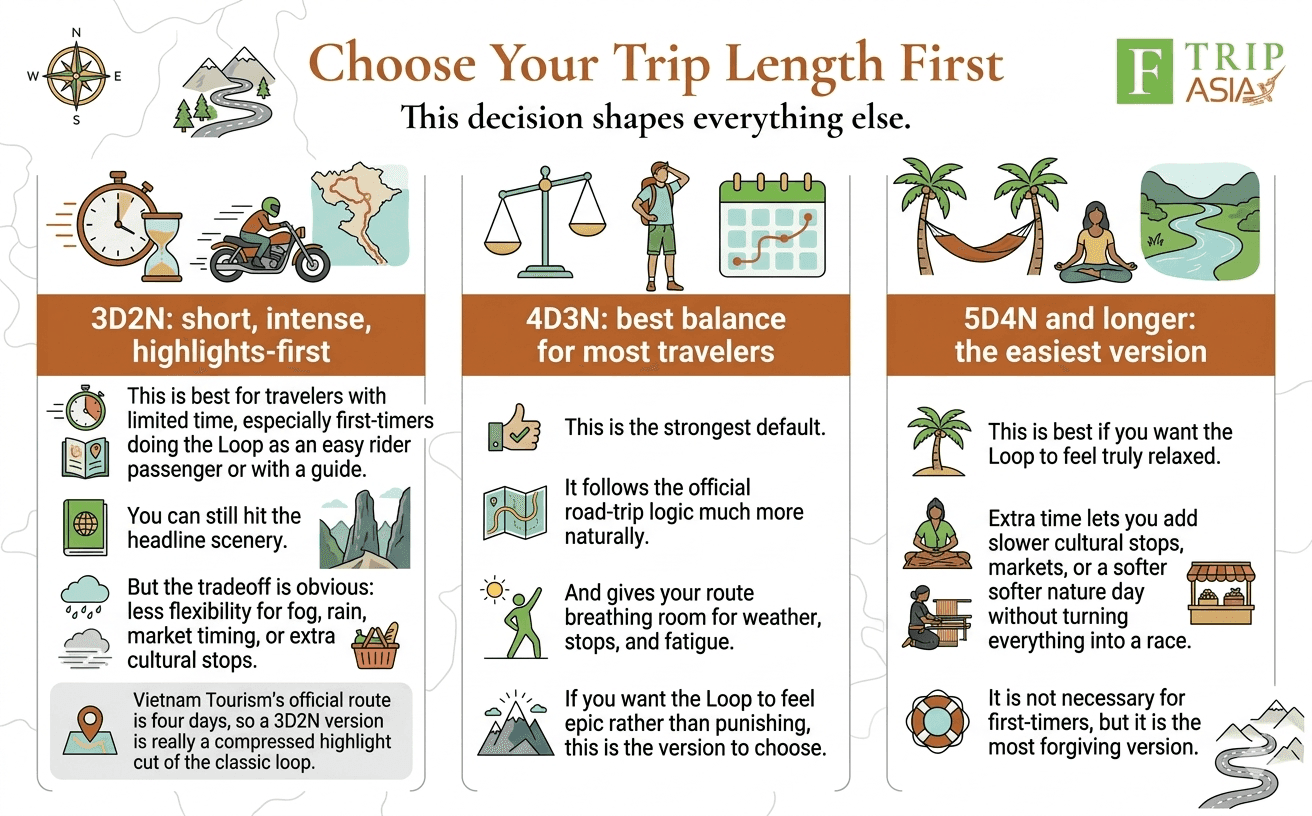
- Choose Your Trip Length First
- 3D2N: short, intense, highlights-first
- 4D3N: best balance for most travelers
- 5D4N and longer: the easiest version
- Pick Your Sleep Anchors
- Protect the Hero Segment
- Add Only 1–2 “Beyond the Passes” Experiences
- Check Permits and Checkpoints Early
- Time Your Loop by Season
- Best windows for most travelers
- Harder window
- Plug-and-Play Templates
- Template A: 3D2N “Iconic highlights”
- Template B: 4D3N “Classic loop logic” (recommended)
- Template C: 5D4N “Creative + relaxed”
- Your Booking and Prep Checklist
- FAQs
- What is the classic Ha Giang Loop route and which roads matter?
- Is 3D2N enough, or is 4D3N better?
- Do I need a permit for checkpoints in Ha Giang?
- When is the best season to ride for visibility and comfort?
- Why is the landscape so dramatic in Dong Van?
- Conclusion
Designing a Ha Giang Loop itinerary feels harder than it should because the map lies a little. Distances can look short, but mountain roads, fog, photo stops, and checkpoints stretch every day. The easiest way to make the Loop feel manageable is to build it around the classic backbone first, then add only a few meaningful extras. Vietnam Tourism’s official four-day route already gives you that backbone: QL4C northeast out of Ha Giang, then QL34 southwest back, with overnight logic built around the main mountain towns.
For most travelers, the cleanest plan is simple: choose your trip length, lock in your sleep anchors in Yen Minh, Dong Van, and Meo Vac, then protect the Dong Van ↔ Meo Vac / Ma Pi Leng section as your hero day. Much of the Loop’s dramatic scenery sits within the Dong Van Karst Plateau UNESCO Global Geopark, which is one reason the landscape feels so different from the rest of Vietnam. Foreign travelers are also commonly advised to carry a border travel permit for the classic route because checkpoints may ask for it.
Choose Your Trip Length First
This decision shapes everything else.
3D2N: short, intense, highlights-first
This is best for travelers with limited time, especially first-timers doing the Loop as an easy rider passenger or with a guide. It works because you can still hit the headline scenery, but the tradeoff is obvious: less flexibility for fog, rain, market timing, or extra cultural stops. Vietnam Tourism’s official route is four days, so a 3D2N version is really a compressed highlight cut of the classic loop.
4D3N: best balance for most travelers
This is the strongest default. It follows the official road-trip logic much more naturally and gives your route breathing room for weather, stops, and fatigue. If you want the Loop to feel epic rather than punishing, this is the version to choose.
5D4N and longer: the easiest version
This is best if you want the Loop to feel truly relaxed. Extra time lets you add slower cultural stops, markets, or a softer nature day without turning everything into a race. It is not necessary for first-timers, but it is the most forgiving version.
Pick Your Sleep Anchors
A Ha Giang Loop itinerary is really just a set of town-to-town legs.
The most practical anchors are:
-
Ha Giang City for your start and finish
-
Yen Minh for your first positioning night
-
Dong Van for the geopark town base
-
Meo Vac for your post–Ma Pi Leng base
This is also how the classic route is usually structured in official and operator itineraries. Using these towns as fixed overnight pins keeps the map simple and stops you from overcomplicating the ride.
Protect the Hero Segment
Every good Loop itinerary has one day you should not ruin with bad pacing.
That day is:
Dong Van → Ma Pi Leng area → Meo Vac
This is the Loop’s defining section. It is where the limestone walls, gorge views, and road drama peak. It looks short on the map, but it rides slowly in reality because of curves, exposure, viewpoint stops, and the simple fact that you will want to stop more than you think. Vietnam Tourism’s official route and many recent route guides treat this as the highlight segment for a reason.
Two rules protect this day:
-
Start early
-
Keep stops intentional
A few high-value stops always work better than trying to stop everywhere.
Add Only 1–2 “Beyond the Passes” Experiences
A better itinerary is not always a bigger itinerary.
If you want the Loop to feel more memorable, add just one or two meaningful extras such as:
-
a market morning
-
a river or gorge perspective
-
a village or waterfall reset day on longer routes
In 3D2N, keep extras very limited or the trip turns into a sprint. In 4D3N, one cultural add-on fits much more naturally. In 5D+, you can start layering in slower experiences without breaking the route rhythm.
Check Permits and Checkpoints Early
This is one of the easiest things to solve before departure and one of the most annoying things to ignore.
Recent Ha Giang permit guides commonly advise foreign travelers to carry a border travel permit on the classic route through Quan Ba, Yen Minh, Dong Van, and Meo Vac, because checkpoints may request it. The most practical move is to ask your hostel, homestay, or tour operator to help arrange it and to keep your passport details ready.
I was not able to verify one single official government page that lays out the full current traveler process, so operator or accommodation support remains the most practical source for up-to-date permit handling. That part is worth confirming before you ride.
Time Your Loop by Season
Best windows for most travelers
The strongest broad windows are March–May and September–November. Recent Ha Giang guides consistently recommend these for better comfort, clearer conditions, and stronger scenery.
Harder window
May–September is often described as wetter and trickier for road conditions. It can still be beautiful and lush, but it is less forgiving for a DIY itinerary because visibility and traction can change fast.

Plug-and-Play Templates
Template A: 3D2N “Iconic highlights”
Day 1: Ha Giang City → Quan Ba area → Yen Minh
Day 2: Yen Minh → Dong Van → Ma Pi Leng → Meo Vac
Day 3: Meo Vac → return toward Ha Giang City
This is the compressed highlight version of the Loop. It works if you stay disciplined and accept long days. It is essentially a shortened version of the official four-day structure.
Template B: 4D3N “Classic loop logic” (recommended)
Day 1: Ha Giang City → Yen Minh
Day 2: Yen Minh → Dong Van
Day 3: Dong Van → Meo Vac
Day 4: Return via the classic return corridor to Ha Giang City
This follows the official QL4C out / QL34 back logic and gives the route the pace it deserves. For most travelers, this is the best version to copy first, then tweak.
Template C: 5D4N “Creative + relaxed”
Use Template B, then add:
-
one market morning, or
-
one slower village or waterfall day
This is the best version if you care more about depth, culture, and photography than simply “finishing the Loop.”
Your Booking and Prep Checklist
Before you go, confirm these:
-
your travel style: easy rider, self-ride, or car
-
your permit plan
-
offline maps downloaded
-
sleep anchors pinned
-
fuel stops pinned
-
mountain-weather packing ready
For packing, bring:
-
layers
-
a light rain shell
-
shoes with grip
-
gloves or eye protection
-
waterproof phone protection
-
a power bank
These are simple, but they matter a lot on a route where weather and road conditions change quickly.
FAQs
What is the classic Ha Giang Loop route and which roads matter?
The classic loop follows QL4C northeast from Ha Giang and returns southwest via QL34. The core towns are Ha Giang City, Yen Minh, Dong Van, and Meo Vac.
Is 3D2N enough, or is 4D3N better?
3D2N is enough for the highlights. 4D3N is better for most travelers because it gives more room for weather, stops, and a calmer pace.
Do I need a permit for checkpoints in Ha Giang?
Foreign travelers are commonly advised to carry a border travel permit on the classic route because checkpoints may ask for it in the main border-region districts.
When is the best season to ride for visibility and comfort?
Usually March–May and September–November. These periods are the most consistently recommended in recent Ha Giang travel guidance.
Why is the landscape so dramatic in Dong Van?
Because this area sits in the Dong Van Karst Plateau UNESCO Global Geopark, where limestone karst terrain dominates the route.
Conclusion
Designing your own Ha Giang Loop itinerary is much simpler when you treat it like a map-based story. Pick your duration, lock in your sleep anchors, protect the Dong Van–Meo Vac hero segment, and add only one or two meaningful extras. The cleanest planning logic is still the classic QL4C out / QL34 back structure.
Handle permits and checkpoints early, download offline navigation, and aim for spring or autumn if you want the best odds of clear, comfortable riding. Once those pieces are in place, the Loop stops feeling overwhelming and starts feeling like what it should be: a dramatic mountain journey you can actually enjoy.


Founder & Photography Guide
Specialties: Culture, landscape, portrait, hiking, active and adventurous tour
Besides my unlimited passion for traveling, a professional tour guide for over a decade, I have been taking photographs since sitting at Hanoi of the University of Culture in the early 2000s. Photography started as a hobby but it was seriously taken due to my work relations and my significant passion for the beauty of our world, especially in Southeast Asian parts such as Vietnam, Laos, Cambodia, and Myanmar.
Within a few years of taking photographs, my works began to be recognized by many reliable international publications such as AFAR Travel, The Times, and The Daily Telegraph newspaper. In addition, I continuously add to my growing profile by winning numerous major awards: 3rd Position of The Independent Photographer 2018, 1st Position of Amateur Photographer of the year 2018, Grand Prize Winner of the AFAR Travel Photography 2019, and a Gold Award of San Francisco Bay International Photography 2020.
I photograph a wide variety of subjects, from travel to landscapes to street scenes. I enjoy documenting the East’s rich cultural heritage and its land soaked in glorious sunrise or sunset light in remote and secluded spots. And, I am very happy to share my knowledge and experience with you. You can visit Luminousvietnamtour to explore tour!


 David and wife (Australia)
 Curious534121
 726hannes
 Planning a Trip to Vietnam from Canada? Start Here.
 14-Day Tour: Classic Cambodia & Southern VietnamFrom$1565/pax
 14 Day Tour Ha Giang & Ha Long Bay for a Complete Northern Vietnam Discovery