

- What “Accessible” Should Mean on a Ha Giang Loop Tour?
- Why is a Ha Giang Loop Tour from Hanoi Easier Than DIY?
- Hanoi to Ha Giang Transport: How Tours Usually Handle It?
- Option A: Night sleeper or cabin bus
- Option B: Day limousine or day bus
- The low-stress arrival strategy
- The Loop Map in Plain English
- Best Tour Lengths
- 3D2N: the most accessible short version
- 4D3N: best balance
- 5 days or more: the gentlest version
- What You’ll See Beyond “Just a Motorbike Route”?
- Permits, Checkpoints, and Why Tours Help
- How to Choose the Right “Accessible” Tour?
- Packing Notes
- FAQs
- How long is the bus or limousine from Hanoi to Ha Giang?
- Is 3D2N enough for the Ha Giang Loop?
- Do foreigners need a permit for Ha Giang Loop checkpoints?
- What is the Dong Van Karst Plateau UNESCO Global Geopark?
- Can I do the Loop without riding a motorbike myself?
- Conclusion
Northern Vietnam can look intimidating on a map. The distances are long, the roads get mountainous, and the logistics can feel fragmented if you try to piece everything together yourself. A Ha Giang Loop tour from Hanoi makes the region much more accessible because it usually combines the Hanoi transfer, the Loop routing, overnight stops, and on-the-ground support into one guided sequence. Vietnam Tourism’s official Ha Giang Loop guide presents the route as a multi-day road trip through Quan Ba, Yen Minh, Dong Van, and Meo Vac, while Hanoi–Ha Giang bus listings commonly place the transfer at about 6–7 hours depending on operator and traffic.
For most first-timers, that is the real value of booking a tour from Hanoi: it removes the two hardest parts at once. First, it gets you into Ha Giang smoothly. Second, it gives you a proven loop structure through one of Vietnam’s most dramatic landscapes, much of it within the Dong Van Karst Plateau UNESCO Global Geopark. Add easy rider support, permit guidance, and accommodation already lined up, and the trip stops feeling remote in a stressful way and starts feeling remote in the best possible way.
What “Accessible” Should Mean on a Ha Giang Loop Tour?
A genuinely accessible Ha Giang Loop tour should mean more than just “we sell you a bus ticket and a motorbike.” It should mean one booking that covers the core moving parts: Hanoi transfer, Loop routing, overnights, and a guide or easy rider option. That is what makes the route approachable for travelers who want the scenery without spending days solving transport, route logic, or checkpoint questions on their own. Vietnam Tourism’s official four-day Loop article already shows that the ride works best as a structured sequence, not as a random collection of viewpoints.
Accessible also means realistic pacing. The Loop is famous because the roads cross high passes and deep valleys, not because it is easy driving. Vietnam Tourism explicitly describes the route as crossing “high passes and deep abysses,” which is why guided pacing and local support matter so much for first-timers.
Finally, accessible should include admin clarity. Current permit guides consistently say foreign travelers are commonly advised to carry a border travel permit on the classic route through Quan Ba, Yen Minh, Dong Van, and Meo Vac because checkpoints may ask for it. A good tour should either arrange this or explain exactly how it works.
Why is a Ha Giang Loop Tour from Hanoi Easier Than DIY?
The first friction point is getting to Ha Giang itself. If you are starting in Hanoi, the route is not difficult, but it does require a real transfer. Baolau says Hanoi to Ha Giang takes about 6–7 hours by bus, while 12Go listings show many limousine and cabin-bus options clustering around the 6-hour mark depending on service type.
The second friction point is the Loop itself. The roads are not just transport corridors. They are the attraction, which also means they demand more attention, more recovery time, and more day-by-day planning than a normal bus-based trip. A guided tour simplifies that by using known overnight anchors, known rest stops, and a route that already matches the terrain. Vietnam Tourism’s classic Loop structure uses Ha Giang City → Yen Minh → Dong Van / Meo Vac → return, which is a strong clue that the route works best when broken into proven riding days.
This is even more important for non-riders. If you are not properly licensed or not confident on mountain roads, the easiest way to do the Loop is as an easy rider passenger. That lets you experience the Loop without taking on the full physical and legal burden of self-riding. Permit and checkpoint guidance also reinforces that foreigners should not assume the route is friction-free if they ride on their own.
Hanoi to Ha Giang Transport: How Tours Usually Handle It?
Option A: Night sleeper or cabin bus
This is one of the most common tour formats because it saves a day. You leave Hanoi in the evening, sleep on the road, and arrive in Ha Giang ready for a morning start or at least a morning briefing. Current route platforms show many night departures, and overall journey times are commonly around 6 hours, sometimes a bit longer depending on pickup pattern and traffic.
This is best for travelers who want to maximize time on the Loop itself.
Option B: Day limousine or day bus
This is the better fit for travelers who do not sleep well on buses or simply prefer to arrive while it is still daylight. Listings commonly show the Hanoi–Ha Giang daytime run at around 6 to 6.5 hours, though some services run longer.
This usually leads to the simplest arrival-night rhythm: arrive, check in, eat, attend the briefing, sleep early, then start the Loop the next morning.
The low-stress arrival strategy
The best arrival-night plan is boring in the best way: arrive, check in, have dinner, get the route briefing, and sleep early. That protects your Day 1 energy and makes the Loop feel much more manageable than trying to improvise after a long transfer.
The Loop Map in Plain English
The core anchor chain is usually:
- Ha Giang City
- Yen Minh
- Dong Van
- Meo Vac
- then back toward Ha Giang
That is the classic skeleton of the route and the one most often reflected in both tourism guides and tour itineraries.
The single segment you should mentally mark as the “hero day” is Dong Van ↔ Meo Vac, especially the Ma Pi Leng area. It looks short on a map, but it rides slowly in reality because it combines sharp curves, cliff-edge scenery, and constant photo-stop temptation. That is why good tours protect this section instead of overfilling the same day with too many extra commitments. Vietnam Tourism’s Loop materials treat Ma Pi Leng as one of the route’s defining highlights.
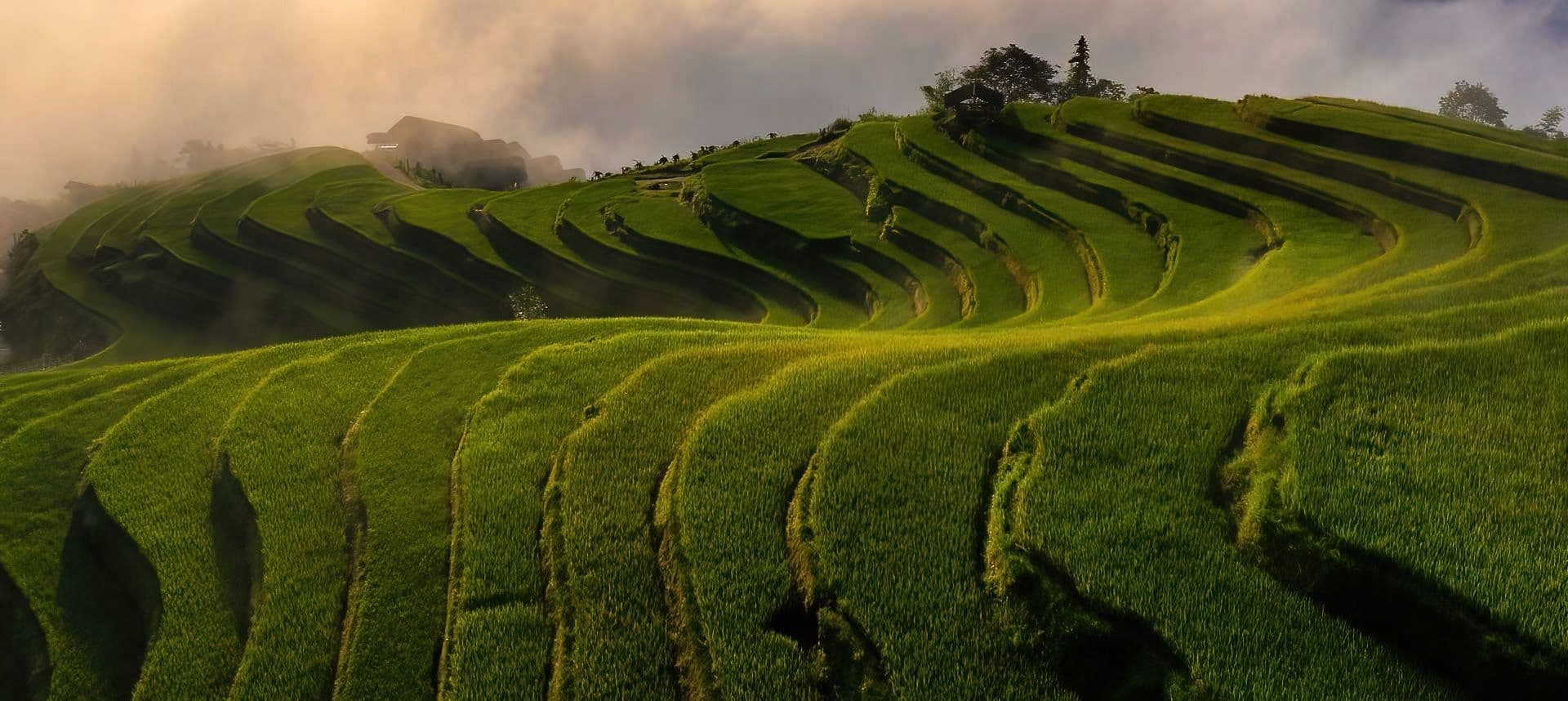
The reason the landscape feels so unreal is geology, not just altitude. UNESCO identifies the Dong Van Karst Plateau UNESCO Global Geopark as being in Ha Giang Province, and the geopark covers the exact districts that give the Loop its limestone identity.
Best Tour Lengths
3D2N: the most accessible short version
This is the best fit if you have limited time but still want the headline Loop experience. It usually works like this:
Night 0: Hanoi to Ha Giang transfer
Day 1: Ha Giang → Quan Ba area → Yen Minh
Day 2: Yen Minh → Dong Van → Ma Pi Leng → Meo Vac
Day 3: Return toward Ha Giang, then either rest or connect back out
This version is popular because it captures the main story arc, but the tradeoff is obvious: long days and less flexibility if the weather shifts. That tradeoff follows the classic route structure and the reality that the Loop is mountain-road travel, not simple highway movement.
4D3N: best balance
This is the better option for most travelers. It gives more room for stops, better timing for viewpoints, and a less compressed overall rhythm. Vietnam Tourism’s official Loop guide is built around a four-day road trip, which is a strong sign that 4D3N is the most natural pacing for the region.
If you want the biggest scenery with less pressure, this is the default choice to make.
5 days or more: the gentlest version
Longer itineraries usually add more village time, extra market opportunities, or softer reset segments such as Du Gia on some route variants. This is less common for quick Hanoi departures, but it is the most accessible version for travelers who want the route to feel spacious instead of intense. Current route guides mention Du Gia as a common scenic add-on to the standard loop shape.
What You’ll See Beyond “Just a Motorbike Route”?
The big postcard scenery is the obvious draw: karst plateau roads, ridge viewpoints, gorge landscapes, and the Ma Pi Leng section. But the Loop works better when it also includes the human side: market mornings, homestay dinners, local food, and quiet mountain-town stops. Vietnam Tourism’s official route is notable because it includes not only road highlights but also local markets and places like Lung Cu, which makes the experience feel broader than pure road drama.
The geology also matters. This is not just “pretty mountains.” UNESCO’s listing and geopark references make clear that this is a globally recognized karst landscape with unusual geological value, which is one reason the scenery feels so distinct from other parts of Vietnam.
On longer tours, some operators also add softer-adventure elements such as Du Gia waterfall or village resets, which helps the trip feel more varied and less like nonstop road time.
Permits, Checkpoints, and Why Tours Help
This is one of the least glamorous but most useful reasons to book a tour from Hanoi. Current Ha Giang permit guides say foreign travelers are commonly advised to carry a border travel permit because several classic Loop highlights sit in regulated border districts and checkpoints may ask for documents.
There is some variation in how sources describe the exact process, but the consistent pattern is this: a good operator or accommodation can often help arrange the permit or tell you exactly what to do. That kind of support is a big part of what makes the route feel accessible rather than intimidating.
How to Choose the Right “Accessible” Tour?
The first thing to confirm is transport clarity. You want to know:
- exact pickup point in Hanoi
- whether the vehicle is cabin bus, sleeper bus, or limousine
- where you arrive in Ha Giang
That matters because the transfer is your first impression of the trip, and bus formats vary a lot even when the marketing language sounds similar.
Second, confirm the travel style:
- easy rider
- self-ride
- car or jeep
If self-ride is allowed, do not assume the licensing side is informal. Current checkpoint guidance suggests foreigners should be careful about paperwork and expectations.
Third, look at group size. Smaller groups usually move more smoothly, stop more naturally, and feel calmer on scenic sections. That is especially important on a short 3D2N route.
Finally, confirm the actual essentials:
- accommodation standard
- meals
- rain plan
- permit support
- helmet and safety-gear quality
That is the difference between a tour that feels genuinely accessible and one that only looks simple on paper.
Packing Notes
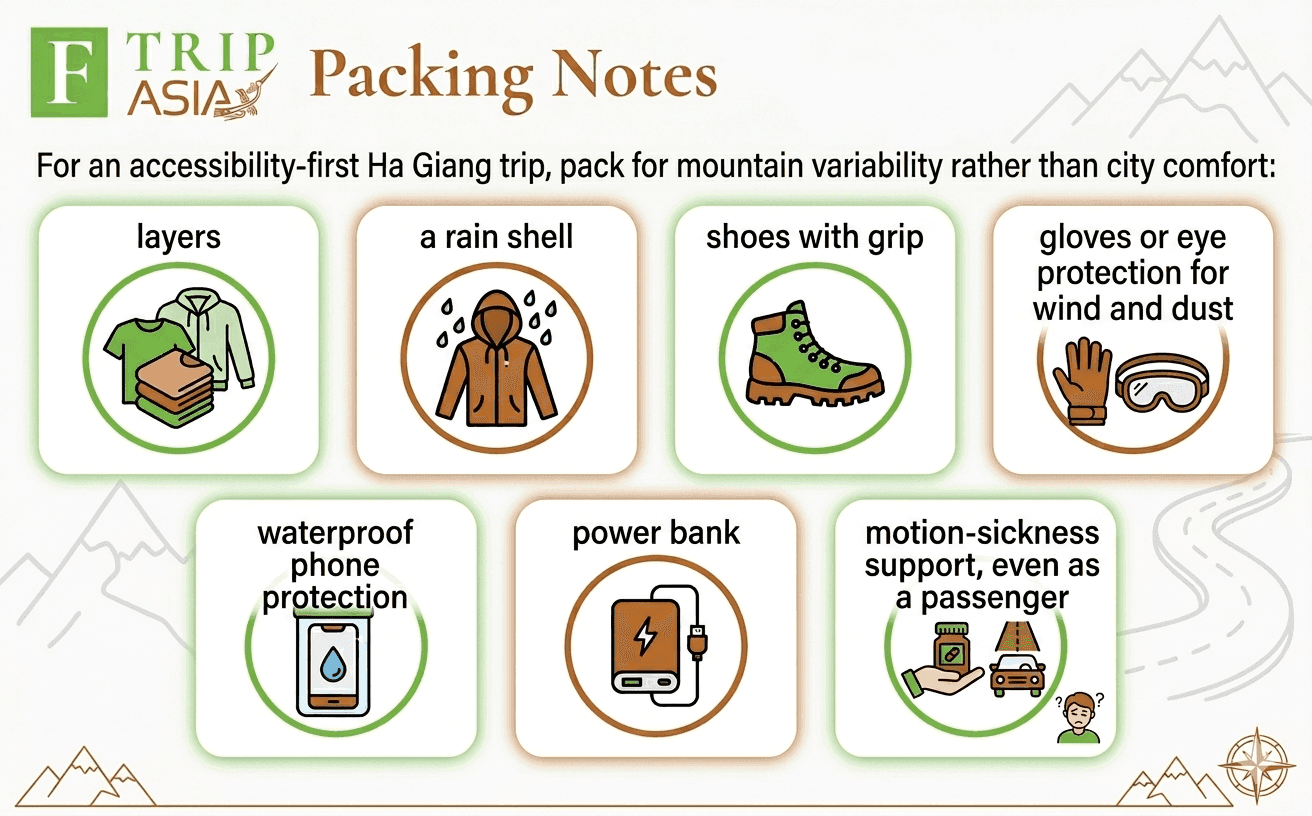
For an accessibility-first Ha Giang trip, pack for mountain variability rather than city comfort:
- layers
- a rain shell
- shoes with grip
- gloves or eye protection for wind and dust
- waterproof phone protection
- power bank
- motion-sickness support, even as a passenger
These are practical basics for a route where weather changes fast and road days can be long. The geology may be the reason you go, but comfort is what helps you actually enjoy it.
FAQs
How long is the bus or limousine from Hanoi to Ha Giang?
Usually about 6 to 7 hours, depending on the operator, traffic, and whether pickup adds extra time.
Is 3D2N enough for the Ha Giang Loop?
Yes, if you want the highlights-focused version. But 4D3N is better for comfort, scenery timing, and less rushing. Vietnam Tourism’s official Loop route is structured as four days.
Do foreigners need a permit for Ha Giang Loop checkpoints?
Current guides commonly advise yes for the classic route, because checkpoints may ask for a border travel permit in the main border-region districts.
What is the Dong Van Karst Plateau UNESCO Global Geopark?
It is a UNESCO Global Geopark in Ha Giang Province, covering the core limestone districts that define the Loop’s most famous scenery.
Can I do the Loop without riding a motorbike myself?
Yes. The most straightforward option is to join as an easy rider passenger, which is why many first-timers choose a guided tour from Hanoi instead of self-riding.
Conclusion
A Ha Giang Loop tour from Hanoi makes northern Vietnam more accessible because it turns a complicated-looking route into a clear sequence: a straightforward Hanoi transfer, a proven set of overnight anchors, and support for the parts that usually create stress, like permits, pacing, and route logic.
If you want the biggest scenery with the least confusion, choose 4D3N if possible, or 3D2N if time is tight, and pick a tour that is transparent about transport, group size, and safety. That is usually the easiest way to make Ha Giang feel not remote and difficult, but remote and unforgettable.


Founder & Photography Guide
Specialties: Culture, landscape, portrait, hiking, active and adventurous tour
Besides my unlimited passion for traveling, a professional tour guide for over a decade, I have been taking photographs since sitting at Hanoi of the University of Culture in the early 2000s. Photography started as a hobby but it was seriously taken due to my work relations and my significant passion for the beauty of our world, especially in Southeast Asian parts such as Vietnam, Laos, Cambodia, and Myanmar.
Within a few years of taking photographs, my works began to be recognized by many reliable international publications such as AFAR Travel, The Times, and The Daily Telegraph newspaper. In addition, I continuously add to my growing profile by winning numerous major awards: 3rd Position of The Independent Photographer 2018, 1st Position of Amateur Photographer of the year 2018, Grand Prize Winner of the AFAR Travel Photography 2019, and a Gold Award of San Francisco Bay International Photography 2020.
I photograph a wide variety of subjects, from travel to landscapes to street scenes. I enjoy documenting the East’s rich cultural heritage and its land soaked in glorious sunrise or sunset light in remote and secluded spots. And, I am very happy to share my knowledge and experience with you. You can visit Luminousvietnamtour to explore tour!

 David and wife (Australia)
 Curious534121
 726hannes
 Planning a Trip to Vietnam from Canada? Start Here.
 14-Day Tour: Classic Cambodia & Southern VietnamFrom$1565/pax
 14 Day Tour Ha Giang & Ha Long Bay for a Complete Northern Vietnam Discovery