
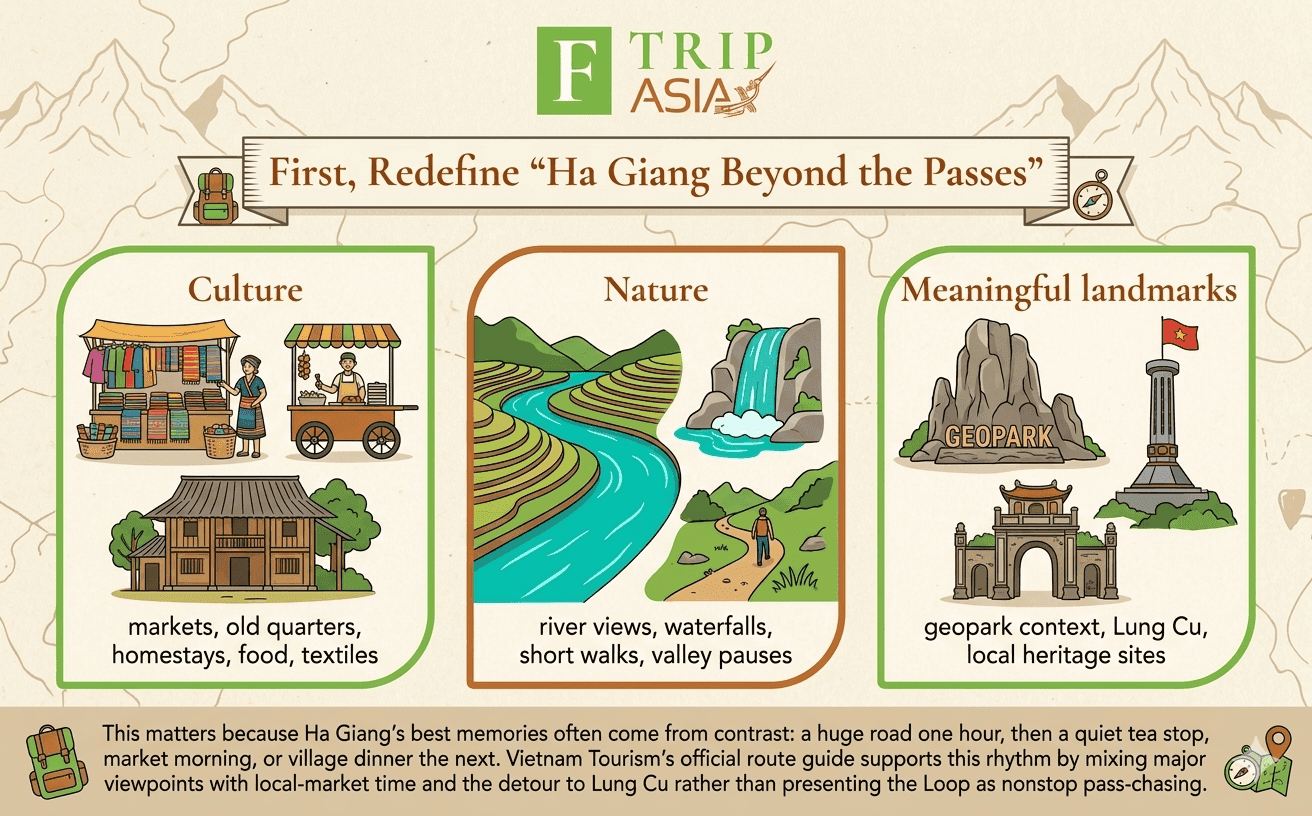
- First, Redefine “Ha Giang Beyond the Passes”
- Explore the Highland Markets
- Dong Van Market
- Timing tip
- The practical rule
- Do the Nho Que River for a Completely Different Perspective?
- Why it is worth doing even if you already saw Ma Pi Leng
- How to plan it well
- Visit Lung Cu for a Landmark Moment
- Practical reality check
- Swim and Reset in Du Gia
- Why Du Gia changes the feel of the trip
- Best way to do it
- Spend Time in the Old Quarters and Small Towns
- Dong Van Old Quarter
- Coffee and viewpoint pairing
- Add Short Walks and Micro-Hikes
- Go Deeper Into the Geopark Story
- Culture-First Experiences Travelers Often Skip
- Homestay dinner and slower evening
- Local food in markets
- Respectful portrait practice
- Easy “Beyond the Passes” Inserts
- For 3D2N
- For 4D3N or longer
- FAQs
- What is Dong Van Market and when should I go?
- Is Nho Que River worth doing if I’m already seeing Ma Pi Leng viewpoints?
- How hard is the climb at Lung Cu Flag Pole?
- Where can I swim or relax on the Ha Giang route?
- What is the Dong Van Karst Plateau UNESCO Global Geopark?
- Conclusion
Most travelers come to Ha Giang for the legendary mountain roads, but the region becomes far more memorable when you add markets, rivers, villages, small-town evenings, and slower cultural stops to the route. Vietnam Tourism’s official Ha Giang Loop guide already hints at this by weaving in local markets, Lũng Cú, and roadside cultural stops alongside the big road sections, while UNESCO recognition of the Dong Van Karst Plateau Global Geopark gives the whole area a deeper identity than just “a scenic ride.”
If you want Ha Giang beyond the passes, the strongest additions are Dong Van Market for cultural life, the Nho Que River for a gorge-level perspective, Lung Cu Flag Pole for symbolism and panorama, and Du Gia for a calmer village-and-waterfall reset. Add one or two of these to your route, and the trip starts to feel multidimensional instead of just a string of viewpoints.
First, Redefine “Ha Giang Beyond the Passes”
The easiest way to think about Ha Giang beyond the famous roads is in three layers:
- Culture: markets, old quarters, homestays, food, textiles
- Nature: river views, waterfalls, short walks, valley pauses
- Meaningful landmarks: geopark context, Lung Cu, local heritage sites
This matters because Ha Giang’s best memories often come from contrast: a huge road one hour, then a quiet tea stop, market morning, or village dinner the next. Vietnam Tourism’s official route guide supports this rhythm by mixing major viewpoints with local-market time and the detour to Lung Cu rather than presenting the Loop as nonstop pass-chasing.
Explore the Highland Markets
Dong Van Market
If you want the highest cultural return for the least extra effort, prioritize Dong Van Market. Multiple guides describe it as a vibrant ethnic market where locals gather to trade produce, textiles, livestock, handicrafts, and food, and Vinpearl’s Dong Van Market guide notes that it operates on Sunday mornings, beginning as early as 5:00 a.m. and staying lively into late morning or early afternoon.
What makes it worth your time is that it is not just a shopping stop. It is one of the clearest places to see Ha Giang as a lived-in highland region rather than a road-trip backdrop. Traditional clothing, produce, conversation, livestock trading, and food stalls all give you a more human-scale memory than one more quick roadside photo.
Timing tip
Go early in the morning, ideally before the most crowded period passes. The earlier you arrive, the more active and less tour-shaped the atmosphere usually feels. This is directly supported by Dong Van Market guides that describe the market’s most active hours as the early morning period.
The practical rule
If your route allows it, let one market morning replace one extra viewpoint stop. You are much more likely to remember the textures, sounds, and people than another rushed platform photo. This is an inference, but it is strongly supported by how Vietnam Tourism itself recommends setting aside time for local markets around Dong Van.
Do the Nho Que River for a Completely Different Perspective?
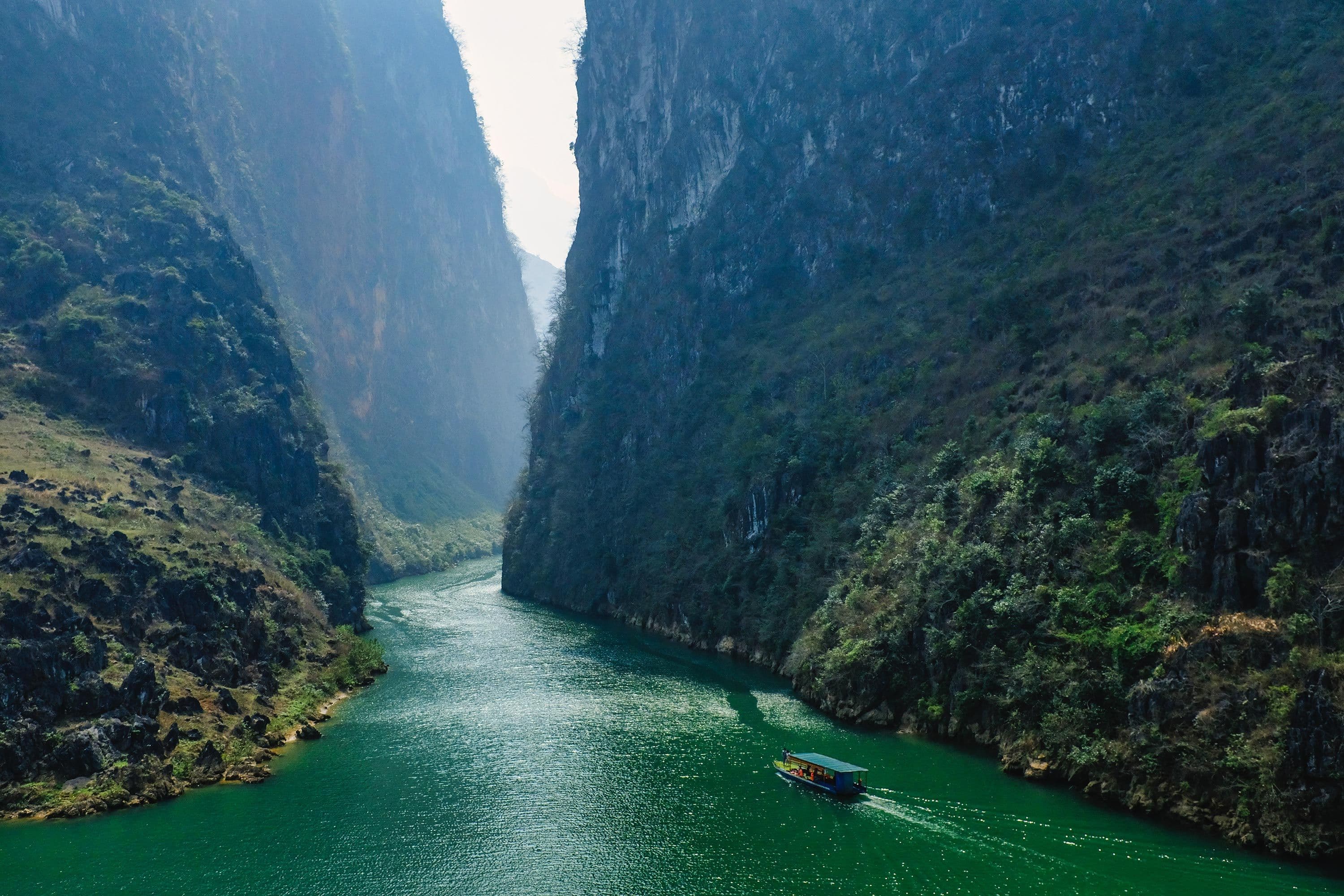
One reason the Nho Que River matters is that it changes your point of view. From Ma Pi Leng Pass, you look down into the gorge. On the river, you are inside that limestone world looking up at the cliffs. That difference makes the river experience feel less like “another Loop stop” and more like a real change of scale. Vietnam Tourism’s official Loop article explicitly links the river to the dramatic Ma Pi Leng section and describes the gorge views as part of the route’s most exhilarating scenery.
Why it is worth doing even if you already saw Ma Pi Leng
Yes, it is worth it. The pass gives you the iconic overview; the river gives you the immersive version. Those are not duplicate experiences. Tour itineraries for the region regularly package the Nho Que boat segment as a separate highlight, which shows how often travelers value it as more than a photo add-on.
How to plan it well
Treat Nho Que as a half-block of your day, not a quick insert. You need time for the transfer, the river segment, and some photo time. It works best when it is not squeezed into the same tight schedule as several distant viewpoints. That is a practical planning inference based on how often regional tours present it as a dedicated experience rather than a five-minute stop.
Visit Lung Cu for a Landmark Moment
Lung Cu Flag Pole is not just another scenic stop. It is one of the region’s most symbolic landmarks, located in Dong Van District near the far north of Vietnam. Vietnam Tourism’s official Ha Giang Loop guide includes Lung Cu as a major detour from the classic route and says the 360-degree views are worth the effort.
What makes Lung Cu different is that it combines landmark meaning with panorama. It is a place people remember not only because of the view, but because it feels like a geographic milestone on the northern edge of the country.
Practical reality check
Expect a climb. If you are already fatigued from long road hours or if the weather is hot, it is smarter to do Lung Cu earlier in the day. That is a practical recommendation rather than a sourced schedule fact, but it follows directly from the effort involved and the official guide’s framing of Lung Cu as a substantial detour rather than a quick roadside glance.
Swim and Reset in Du Gia
If the passes are the high-adrenaline side of Ha Giang, Du Gia is the soft-adventure side. Recent travel coverage describes Du Gia Waterfall as a favorite stop for swimming, cooling off, and resetting after the intensity of the main Loop roads. It is especially valued by travelers who want a break from all-day riding.
Why Du Gia changes the feel of the trip
Du Gia matters because it adds a different texture to the route: water, slower village rhythm, and the feeling of exhaling a bit. It makes Ha Giang feel broader than just karst roads and cliff-edge passes. That is one reason longer itineraries often become much more satisfying once Du Gia is added.
Best way to do it
The strongest version is to overnight nearby, swim in the late afternoon, and leave the next morning more open for village roads and rice-field scenes. This avoids turning Du Gia into just another rushed checkpoint on a packed riding day. That recommendation is an inference from the area’s value as a rest-and-reset stop rather than a drive-by attraction.
Spend Time in the Old Quarters and Small Towns
Dong Van Old Quarter
Not every good moment in Ha Giang comes from a road. Dong Van Old Quarter is one of the best places to slow down after a long day. Vietnam Tourism’s Ha Giang Loop guide specifically suggests setting aside time in Dong Van for a market visit either at night or in the early morning, which supports using the town itself as part of the experience, not only as a sleep stop.
This is the right place for:
- a quiet evening walk
- warm food
- a slower town atmosphere
- a short café stop that lets the day settle
Coffee and viewpoint pairing
One of the best upgrades in Ha Giang is to choose one small-town café or tea stop with a view instead of chasing one extra pass or one extra platform. This is not a sourced rule, but it is a reliable travel strategy in a region where energy matters and the best memories often come from contrast rather than accumulation.
Add Short Walks and Micro-Hikes
Ha Giang is easy to experience as a seated road trip, but even 30 to 60 minutes of walking near a village, valley, or viewpoint adds a lot of depth. It changes your pace, improves your compositions, and gives your body a break from constant riding. This works especially well in geopark areas where the terrain itself is the attraction. UNESCO’s recognition of the Dong Van Karst Plateau helps explain why the landscape rewards slower observation, not just passing through.
For photography, even walking 5 to 10 minutes away from the main stop can give you cleaner frames and less crowd pressure. That is a practical creative tip rather than a sourced fact, but it fits how viewpoint-heavy destinations usually work in reality.
Go Deeper Into the Geopark Story
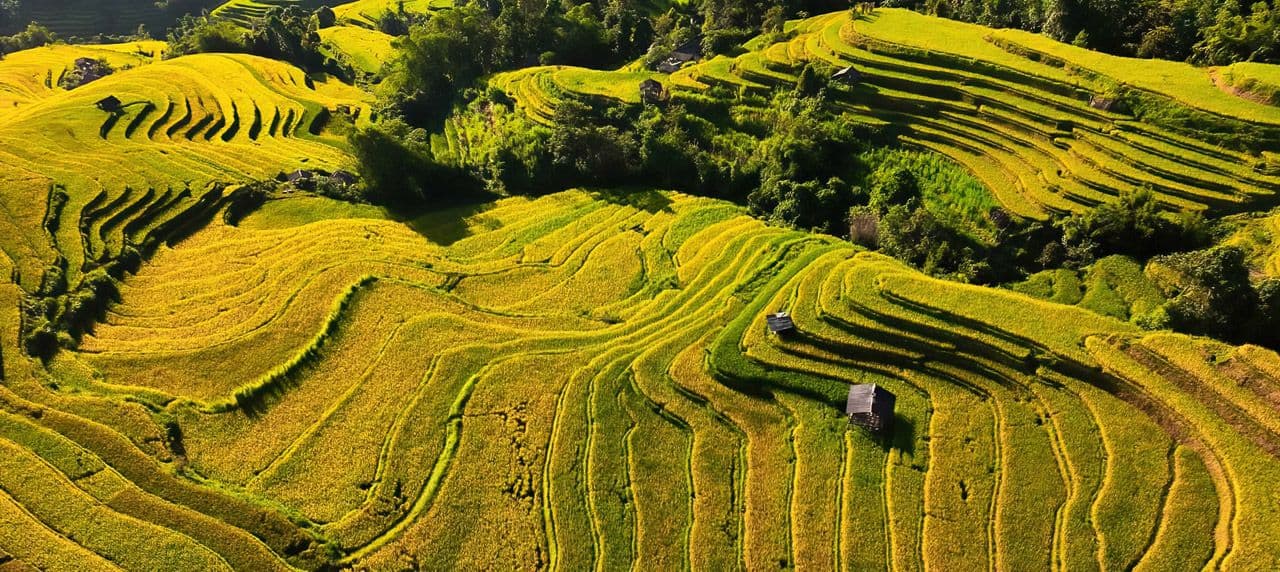
The Dong Van Karst Plateau UNESCO Global Geopark is one of the reasons Ha Giang feels so visually extreme. UNESCO identifies it as a Global Geopark in Ha Giang Province, while Vietnam Airlines describes it as Vietnam’s first UNESCO Global Geopark and one of the largest limestone geoparks in Asia.
What that adds for travelers is meaning. The stone fences, dramatic valleys, severe ridges, and difficult farming conditions all make more sense when you understand that the terrain itself shapes local life. One of the easiest ways to deepen the trip is to ask your guide or homestay host simple questions about:
- why stone fences are common
- how farming works on karst terrain
- why villages sit where they do
- how weather changes movement through the mountains
That turns the Loop from scenery into story.
Culture-First Experiences Travelers Often Skip
The easiest culture-first upgrades are also the least complicated:
Homestay dinner and slower evening
A shared dinner in a homestay often gives you more connection than another roadside photo stop. This is where Ha Giang becomes human-scale.
Local food in markets
Try small portions of local specialties, ask what is seasonal, and use food as part of the cultural experience rather than just a refuel stop. Dong Van Market is especially good for this.
Respectful portrait practice
Ask first, show the photo after when appropriate, and avoid treating villages as open-air photo sets. That is especially important in Ha Giang, where the cultural atmosphere is part of what makes the region memorable.
Easy “Beyond the Passes” Inserts
For 3D2N
Add one market morning or one Nho Que River block. Do not try to force both unless your timing is unusually good.
For 4D3N or longer
The strongest combination is:
- one market morning
- one Nho Que River experience
- one Du Gia overnight
That is where Ha Giang starts feeling truly multidimensional instead of just scenic.
This recommendation is an itinerary inference, but it follows closely from the relative strengths of each stop and the time they need to feel worthwhile.
FAQs
What is Dong Van Market and when should I go?
It is a major highland market in Dong Van Town known for local trade, food, textiles, and ethnic minority cultural life. It is best visited early Sunday morning, when the market is most active.
Is Nho Que River worth doing if I’m already seeing Ma Pi Leng viewpoints?
Yes. The river gives you a gorge-level perspective, which feels very different from looking down from the pass.
How hard is the climb at Lung Cu Flag Pole?
It takes effort and is better done when you are not already exhausted or overheated. Vietnam Tourism presents it as a meaningful detour with wide views, not a quick roadside stop.
Where can I swim or relax on the Ha Giang route?
Du Gia Waterfall is one of the best-known places for a swim and a slower overnight reset.
What is the Dong Van Karst Plateau UNESCO Global Geopark?
It is a UNESCO-recognized geopark in Ha Giang Province known for its limestone karst landscape, geological significance, and dramatic highland scenery.
Conclusion
Ha Giang becomes far more memorable when you mix the famous roads with human-scale experiences: a market morning in Dong Van, a gorge-level perspective on the Nho Que River, a meaningful stop at Lung Cu, and a reset in Du Gia. Those are the kinds of additions that turn the trip from a scenic ride into something you actually feel connected to.
The simplest strategy is to add one or two beyond-pass moments instead of trying to collect every stop. That is usually enough to make Ha Giang feel not just spectacular, but lived in.


Founder & Photography Guide
Specialties: Culture, landscape, portrait, hiking, active and adventurous tour
Besides my unlimited passion for traveling, a professional tour guide for over a decade, I have been taking photographs since sitting at Hanoi of the University of Culture in the early 2000s. Photography started as a hobby but it was seriously taken due to my work relations and my significant passion for the beauty of our world, especially in Southeast Asian parts such as Vietnam, Laos, Cambodia, and Myanmar.
Within a few years of taking photographs, my works began to be recognized by many reliable international publications such as AFAR Travel, The Times, and The Daily Telegraph newspaper. In addition, I continuously add to my growing profile by winning numerous major awards: 3rd Position of The Independent Photographer 2018, 1st Position of Amateur Photographer of the year 2018, Grand Prize Winner of the AFAR Travel Photography 2019, and a Gold Award of San Francisco Bay International Photography 2020.
I photograph a wide variety of subjects, from travel to landscapes to street scenes. I enjoy documenting the East’s rich cultural heritage and its land soaked in glorious sunrise or sunset light in remote and secluded spots. And, I am very happy to share my knowledge and experience with you. You can visit Luminousvietnamtour to explore tour!

 David and wife (Australia)
 Curious534121
 726hannes
 Planning a Trip to Vietnam from Canada? Start Here.
 14-Day Tour: Classic Cambodia & Southern VietnamFrom$1565/pax
 14 Day Tour Ha Giang & Ha Long Bay for a Complete Northern Vietnam Discovery