

- What the “Ha Giang Loop” Map Actually Represents?
- The Loop is not one road
- Why road numbers matter
- Why the landscape changes so dramatically
- How to Read a Ha Giang Loop Map Like a Rider
- Step 1: Mark your sleep anchors
- Step 2: Mark the slow segments
- Step 3: Only add detours if your map has buffer time
- The Classic Loop Map: Core Route and What Each Segment Means
- Ha Giang City → Quan Ba
- Quan Ba → Yen Minh
- Yen Minh → Dong Van
- Dong Van → Meo Vac
- How the loop closes
- Map-Based Itinerary Choices
- 3D2N map shape
- 4D3N map shape
- 5D+ map shape
- Checkpoints and Permits: The Map Zones People Miss
- Navigation Setup So You Do Not Get Lost When Signal Drops
- Pins to save before departure
- Safety Notes That Come Directly From Reading the Map Correctly
- Do not overload your most scenic leg
- Do not trust distance alone
- FAQs
- What is the standard Ha Giang Loop route on the map?
- Which roads are the main Ha Giang Loop roads?
- Should foreigners carry a permit for the classic loop route?
- Is Du Gia part of the Ha Giang Loop map or an optional detour?
- Why does the landscape change so dramatically around Dong Van?
- Conclusion
The Ha Giang Loop looks simple on a map until you realize the “loop” is really a chain of mountain segments, not one continuous easy road. Most travelers start and end in Ha Giang City, then move through Quan Ba, Yen Minh, Dong Van, and Meo Vac, with some itineraries adding Du Gia on the return. Vietnam Tourism’s official four-day route describes the classic structure as following QL4C northeast from Ha Giang and then QL34 southwest back toward Ha Giang, which is the cleanest way to understand the route before you ride.
If you understand the map first, the Loop becomes much calmer. The most useful things to know are: anchor towns are where you sleep and reset, some short-looking sections ride slowly in real life, and foreign travelers are commonly advised to carry a border travel permit for the classic Quan Ba–Yen Minh–Dong Van–Meo Vac corridor because checkpoints can ask for it.
What the “Ha Giang Loop” Map Actually Represents?
The Loop is not one road
Most maps draw the Loop like a clean circle, but in practice it is a multi-day route made of separate riding blocks between sleep towns. Vietnam Tourism’s four-day guide breaks it exactly that way: Ha Giang City to Yen Minh, then onward through the geopark, then the Ma Pi Leng section, then the return. That is the right mental model for planning.
Why road numbers matter
Even if you are not a map person, QL4C and QL34 matter because they help you sanity-check direction. Vietnam Tourism explicitly describes the classic four-day concept as QL4C outbound and QL34 returning. That means if your day plan starts drifting too far off those roads, you should know whether you are doing an intentional detour or just adding complexity.

Why the landscape changes so dramatically
A big reason the map feels so visually extreme is that much of the route crosses the Dong Van Karst Plateau UNESCO Global Geopark. UNESCO says the geopark sits in Ha Giang Province and covers the core districts that define the Loop’s most famous scenery.
How to Read a Ha Giang Loop Map Like a Rider
Step 1: Mark your sleep anchors
The most practical anchor chain is:
- Ha Giang City
- Yen Minh
- Dong Van
- Meo Vac
Those towns are not just labels. They are where you sleep, refuel, eat, and recover. Vietnam Tourism’s official route and current route guides both use these towns as the backbone of the standard Loop.
Step 2: Mark the slow segments
The map can trick you. Some sections look short but ride slowly because of:
- tight curves
- cliffs and exposure
- fog or rain
- constant photo stops
The classic example is Dong Van to Meo Vac via Ma Pi Leng. It is the headline section of the Loop and one of the slowest in real-life pacing relative to map distance. Vietnam Tourism and route guides both single it out as the highlight segment.
Step 3: Only add detours if your map has buffer time
The most common scenic add-on on modern Loop maps is Du Gia. It is widely used as an alternative or extended return shape after Meo Vac, but it works best when you actually have time for it. Current route guides explicitly map Meo Vac → Du Gia → Ha Giang City as an optional scenic finish, not a mandatory part of the core loop.
The Classic Loop Map: Core Route and What Each Segment Means
Ha Giang City → Quan Ba
This is the gateway day. It is where the ride starts to feel mountainous and where many travelers hit their first major viewpoints. Quan Ba Heaven Gate sits on QL4C and is commonly described as the entrance to the Dong Van plateau zone.
Quan Ba → Yen Minh
This is more of a positioning segment than a “tick every stop” segment. The goal is to arrive in Yen Minh with energy rather than overloading the first day. Vietnam Tourism’s official route uses Yen Minh as the first overnight, which is a good clue that the pacing matters.
Yen Minh → Dong Van
This is where the karst-plateau identity becomes much stronger. UNESCO’s geopark coverage and airline/travel guides all point to this zone as the core limestone landscape area.
Dong Van → Meo Vac
This is the segment most people remember. It includes Ma Pi Leng Pass, and travel guides consistently describe it as the signature stretch of the Loop. It is the kind of road section that needs time, not just distance calculations.
How the loop closes
The classic four-day logic is:
- QL4C out
- QL34 back
Vietnam Tourism states this directly in its official route description. Many current itineraries also offer Meo Vac → Du Gia → Ha Giang City as a more scenic modern finish if you have extra time.
Map-Based Itinerary Choices
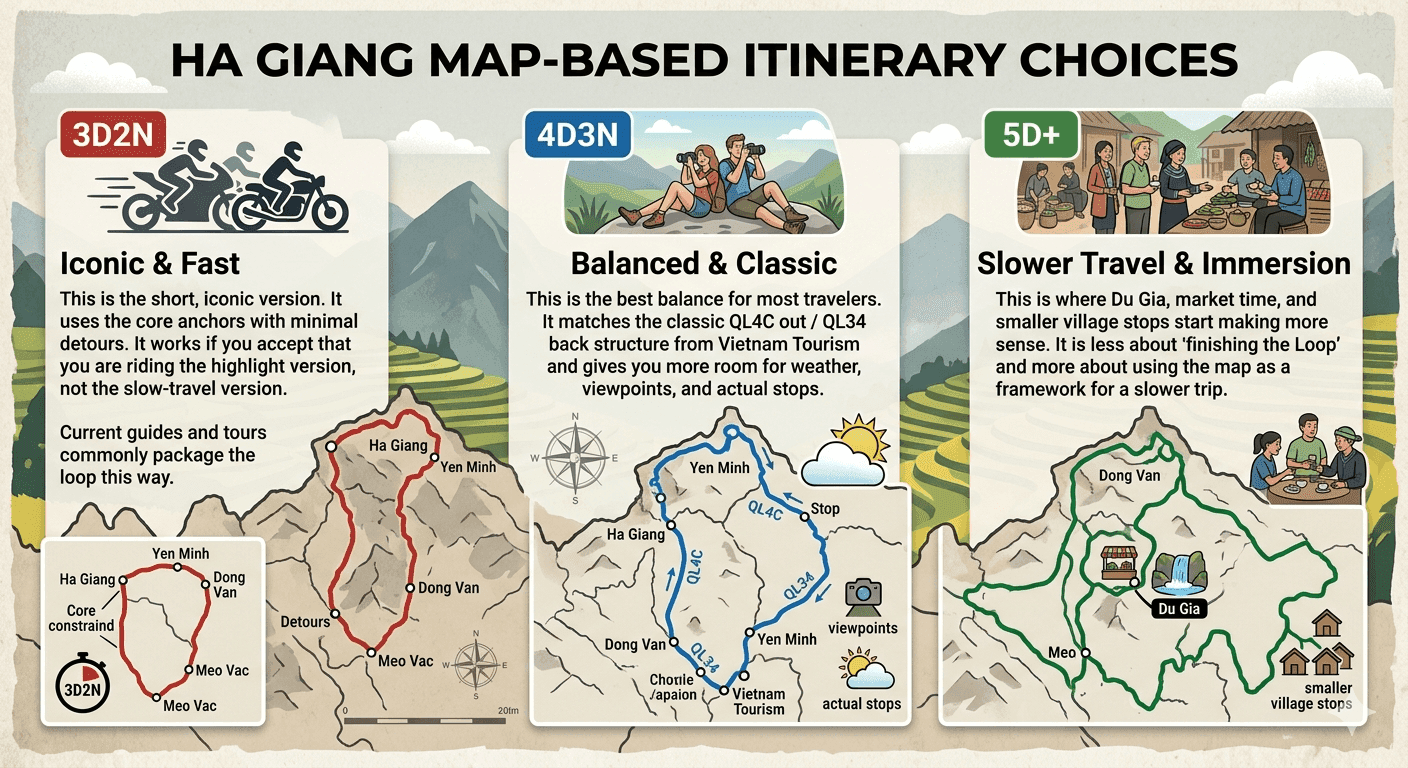
3D2N map shape
This is the short, iconic version. It uses the core anchors with minimal detours. It works if you accept that you are riding the highlight version, not the slow-travel version. Current guides and tours commonly package the loop this way.
4D3N map shape
This is the best balance for most travelers. It matches the classic QL4C out / QL34 back structure from Vietnam Tourism and gives you more room for weather, viewpoints, and actual stops.
5D+ map shape
This is where Du Gia, market time, and smaller village stops start making more sense. It is less about “finishing the Loop” and more about using the map as a framework for a slower trip.
Checkpoints and Permits: The Map Zones People Miss
A lot of riders focus on roads and forget the administrative side. Several current permit guides say the classic Quan Ba–Yen Minh–Dong Van–Meo Vac corridor is commonly treated as a route where foreign travelers should carry a border travel permit to avoid hassle at checkpoints. The same guides say operators or accommodations can often help arrange it.
I could not verify a single up-to-date official government permit page that clearly lays out the full traveler process, so the safest practical move is to confirm the current requirement with your operator or accommodation before departure. The consistent point across recent guides is that carrying the permit is commonly advised.
Navigation Setup So You Do Not Get Lost When Signal Drops
Remote signal gaps are common enough on the Loop that you should assume they will happen at least once. A low-stress setup is:
- download offline maps
- save one pin for each sleep anchor
- save a backup route back to Ha Giang City
- keep one screenshot per day of start town to sleep town
This is practical planning based on the route’s remoteness and how current route guides break the journey into town-to-town segments.
Pins to save before departure
Save these first:
- hotel or hostel in each anchor town
- fuel stations near anchor towns
- one clinic or pharmacy in Dong Van and Meo Vac
Only after that should you save optional experience pins like market mornings, river stops, or short walks.
Safety Notes That Come Directly From Reading the Map Correctly
Do not overload your most scenic leg
If the map shows your most famous segment on that day, assume you will stop more than expected. The Dong Van–Meo Vac section is the classic example. Map distance does not equal riding ease.
Do not trust distance alone
Mountain roads, fog, cliffs, and photo stops all reduce real average speed. That is why riders who “only looked at the map” often end up rushed. The official four-day route structure itself is good evidence that the Loop needs more time than a flat-road distance would suggest.
FAQs
What is the standard Ha Giang Loop route on the map?
The standard map shape is Ha Giang City → Quan Ba → Yen Minh → Dong Van → Meo Vac → return to Ha Giang, often with the classic four-day concept using QL4C outbound and QL34 return.
Which roads are the main Ha Giang Loop roads?
The main structure most often referenced is QL4C for the outbound northeast leg and QL34 for the southwest return leg.
Should foreigners carry a permit for the classic loop route?
Current Ha Giang permit guides commonly advise yes, especially for the Quan Ba–Yen Minh–Dong Van–Meo Vac corridor where checkpoints may ask for it.
Is Du Gia part of the Ha Giang Loop map or an optional detour?
It is best understood as an optional scenic detour or extended finish, not part of the most stripped-down core loop. Many modern maps include it after Meo Vac when travelers have more time.
Why does the landscape change so dramatically around Dong Van?
Because that section sits in the Dong Van Karst Plateau UNESCO Global Geopark, where limestone karst terrain dominates the route.
Conclusion
If you understand the Ha Giang Loop map before you ride, the trip gets much easier. Anchor your days around sleep towns, treat Dong Van–Meo Vac as a slow, photo-heavy section, and use the classic QL4C out / QL34 back structure if you want the cleanest loop logic.
Add the practical layer too: sort out permits and checkpoints before departure, save offline navigation, and pin your essentials first. Once you do that, the Loop stops feeling intimidating and starts feeling like what it actually is: a well-paced mountain journey through one of Vietnam’s most dramatic landscapes.


Founder & Photography Guide
Specialties: Culture, landscape, portrait, hiking, active and adventurous tour
Besides my unlimited passion for traveling, a professional tour guide for over a decade, I have been taking photographs since sitting at Hanoi of the University of Culture in the early 2000s. Photography started as a hobby but it was seriously taken due to my work relations and my significant passion for the beauty of our world, especially in Southeast Asian parts such as Vietnam, Laos, Cambodia, and Myanmar.
Within a few years of taking photographs, my works began to be recognized by many reliable international publications such as AFAR Travel, The Times, and The Daily Telegraph newspaper. In addition, I continuously add to my growing profile by winning numerous major awards: 3rd Position of The Independent Photographer 2018, 1st Position of Amateur Photographer of the year 2018, Grand Prize Winner of the AFAR Travel Photography 2019, and a Gold Award of San Francisco Bay International Photography 2020.
I photograph a wide variety of subjects, from travel to landscapes to street scenes. I enjoy documenting the East’s rich cultural heritage and its land soaked in glorious sunrise or sunset light in remote and secluded spots. And, I am very happy to share my knowledge and experience with you. You can visit Luminousvietnamtour to explore tour!

 David and wife (Australia)
 Curious534121
 726hannes
 Planning a Trip to Vietnam from Canada? Start Here.
 14-Day Tour: Classic Cambodia & Southern VietnamFrom$1565/pax
- 14 Day Tour Ha Giang & Ha Long Bay for a Complete Northern Vietnam Discovery