- Before You Start: Read the Loop in 30 Seconds
- The 4-Day Ha Giang Loop Itinerary
- Day 1 — Ha Giang City → Quan Ba → Yen Minh
- Day 2 — Yen Minh → Dong Van
- Day 3 — Dong Van → Ma Pi Leng Pass → Meo Vac / Pa Vi
- Day 4 — Meo Vac / Bao Lam Corridor → Ha Giang City
- Optional Upgrade: Du Gia Add-On
- Best Time to Do This 4-Day Itinerary
- Safety and Comfort Notes
- What to Pack for 4D3N?
- Booking / DIY Checklist
- FAQs
- Is 4 days enough for the Ha Giang Loop full experience?
- What roads define the classic 4-day loop?
- What’s the highlight day on a 4-day Loop?
- When is the safest season to ride?
- Conclusion
A 4-day Ha Giang Loop itinerary is the sweet spot for most travelers because it gives the route enough space to feel complete without dragging. Vietnam’s official tourism guide presents the Loop as a four-day road trip that starts and ends in Ha Giang City, heads northeast on QL4C, and returns southwest on QL34. That structure works because it matches the geography of the region and gives proper time for the most scenic section around Dong Van, Ma Pi Leng, and Meo Vac.
The best 4-day version is not about squeezing in every stop. It is about using the right sleep anchors, protecting your Ma Pi Leng hero day, and leaving enough breathing room for mountain weather, photo stops, and fatigue. Much of the Loop’s most dramatic terrain sits in the Dong Van Karst Plateau UNESCO Global Geopark, which UNESCO recognizes in Ha Giang Province and which covers the core districts of Quan Ba, Yen Minh, Dong Van, and Meo Vac.
Before You Start: Read the Loop in 30 Seconds
The Ha Giang Loop works best when you think of it as town-to-town legs, not a list of viewpoints. Your real planning units are the places where you sleep and reset: Ha Giang City, Yen Minh, Dong Van, and Meo Vac. Vietnam Tourism’s official route uses this same logic, with Day 1 ending in Yen Minh, Day 3 centered on Dong Van and Ma Pi Leng, and Day 4 returning toward Ha Giang.
The one segment you should treat as protected is Dong Van → Ma Pi Leng → Meo Vac. Even though it looks short on the map, Vietnam Tourism notes that the road from Dong Van to Ma Pi Leng is so scenic that travelers will stop constantly, and that Meo Vac is only 24 km from Dong Van but still takes most of the morning if you properly enjoy the views.

The 4-Day Ha Giang Loop Itinerary
Day 1 — Ha Giang City → Quan Ba → Yen Minh
This is your gateway into the mountains. The goal is not to ride hard. The goal is to enter the highlands gradually and still arrive with energy for the stronger scenery ahead.
The classic first-day highlight is the Quan Ba corridor, especially Quan Ba Heaven Gate, which recent travel coverage describes as the gateway into the Dong Van plateau and a major first-look viewpoint over the karst landscape.
After Quan Ba, continue toward Yen Minh, which is the most practical overnight for a clean start on Day 2. Vietnam Tourism’s official 4-day route ends Day 1 in Yen Minh, which is one of the strongest signals that this is the right pacing for most travelers.
What to prioritize
- Quan Ba / Heaven Gate viewpoints
- a few short, high-value photo stops
- arriving in Yen Minh before dark
Why Yen Minh works
It positions you perfectly for the geopark landscapes ahead without overloading your first day.
Day 2 — Yen Minh → Dong Van
This is the karst plateau day. The road starts to feel more geologically dramatic, and the scenery becomes more recognizably “Ha Giang.” UNESCO’s geopark profile and Vietnam Airlines’ geopark guide both emphasize that the Dong Van plateau is defined by limestone formations, steep valleys, and visually extreme terrain.
This is also the day to begin adding more cultural texture instead of only chasing viewpoints. If timing works, local markets or village craft stops can fit naturally here, but they should support the route, not overload it. The aim is to arrive in Dong Van with enough energy to enjoy the town and be fresh for the next day’s pass segment. Vietnam Tourism’s official route builds Day 3 around Dong Van and Ma Pi Leng, which is why Dong Van is the right overnight base here.
What to prioritize
- longer looks at the valley and karst views
- fewer, better stops instead of constant pulling over
- a slower evening in Dong Van
Why Dong Van works
It is the best launch point for the Loop’s most iconic day.
Day 3 — Dong Van → Ma Pi Leng Pass → Meo Vac / Pa Vi
This is the hero day. Vietnam Tourism describes the road from Dong Van to Ma Pi Leng Pass as arguably the most mind-blowing stretch of road in Vietnam, with peaks, canyons, and nonstop panoramic views. It also notes that although Meo Vac is only 24 km away, the route takes most of the morning because of the number of stops you will want to make.
This is the day that makes the Loop feel legendary. Protect it. Start early, keep earlier stops light, and do not cannibalize Ma Pi Leng time by overplanning the morning. If the weather is clear and your pacing is good, you can consider the Nho Que River detour via 193A, which Vietnam Tourism explicitly mentions as a side road offering a closer look at the river below.
Overnighting in Meo Vac or nearby Pa Vi is the cleanest finish because it lets you absorb the pass properly rather than rushing farther. Current 4-day route guides and operator itineraries commonly use Meo Vac as the post–Ma Pi Leng base.
What to prioritize
- Ma Pi Leng viewpoints
- unhurried ridge-road stops
- late-afternoon light if possible
- Nho Que only if it fits naturally
Photography tip
This is the day to protect your better light. The pass and gorge are the visual center of the whole Loop.
Day 4 — Meo Vac / Bao Lam Corridor → Ha Giang City
This is the closing-the-loop day. Vietnam Tourism says the classic 4-day structure returns from Bao Lam via QL34 southwest toward Ha Giang, following the Gam River for much of the way. It notes that the return still has twists and a few passes, but nothing as strenuous as before.
That makes Day 4 the day to ride more smoothly, use comfortable breaks, and leave yourself a little buffer if you are continuing onward to Hanoi.
What to prioritize
- final panoramic pauses
- lunch and rest breaks without pressure
- arriving in Ha Giang with enough buffer for your next transfer
Why this works
It finishes the trip as a journey, not a sprint.
Optional Upgrade: Du Gia Add-On
If you prefer a softer finish, some modern itineraries add Du Gia instead of following the cleanest classic return. Current Ha Giang route guides frequently describe Du Gia as an alternative scenic finish or add-on for travelers who want more village atmosphere and nature downtime.
This version is best for:
- travelers who value village calm
- people who want a waterfall or swim-style reset
- anyone who prefers less constant road intensity and fewer repeated viewpoint stops
The trade-off is that it moves you away from the simplest QL4C out / QL34 back route logic. That is not wrong, but it is a different style of a 4-day itinerary.
Best Time to Do This 4-Day Itinerary
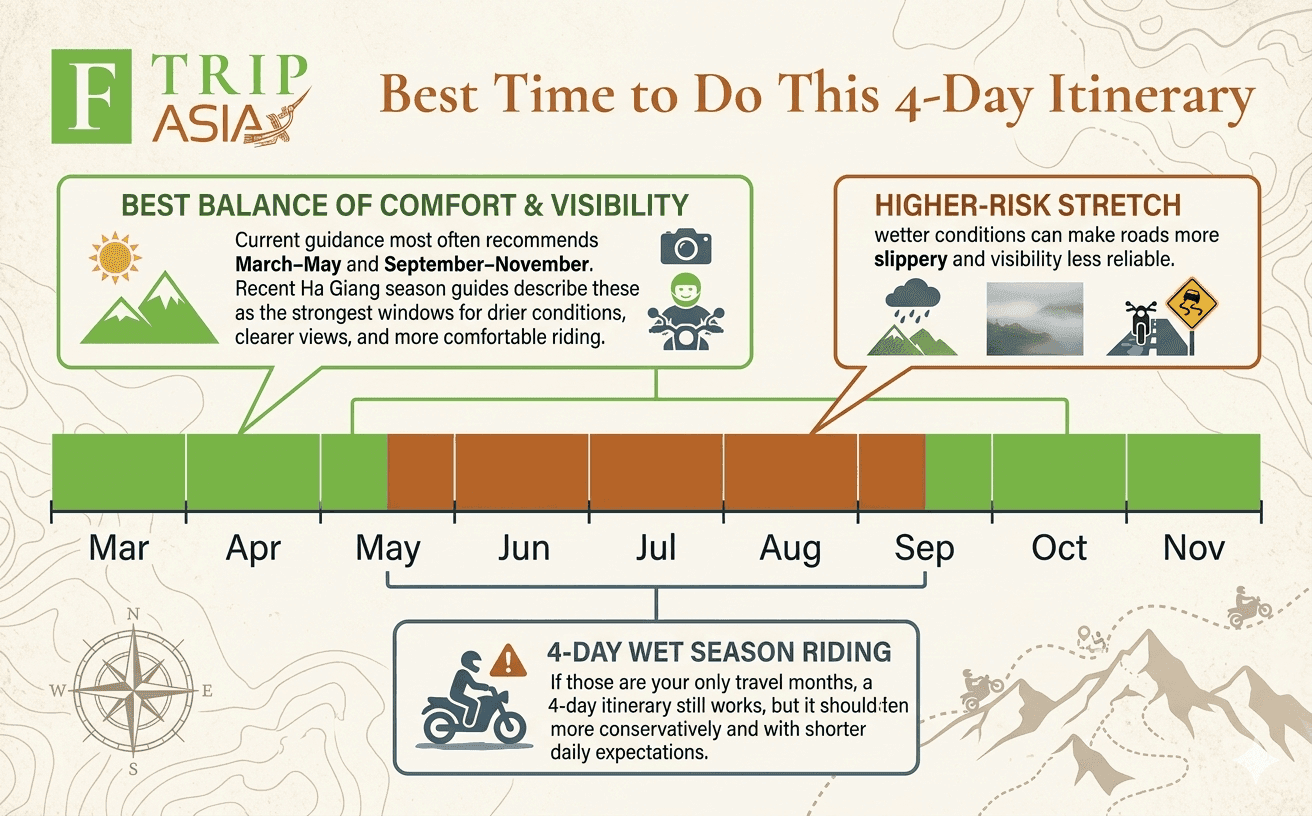
For the best balance of comfort and visibility, current guidance most often recommends March–May and September–November. Recent Ha Giang season guides describe these as the strongest windows for drier conditions, clearer views, and more comfortable riding.
 Confirm
The higher-risk stretch is generally May–September, when wetter conditions can make roads more slippery and visibility less reliable. If those are your only travel months, a 4-day itinerary still works, but it should be ridden more conservatively and with shorter daily expectations.
Safety and Comfort Notes
A complete 4-day Ha Giang Loop is not about speed. It is about making good decisions day after day. Vietnam Tourism’s official route itself is evidence of that: the Loop is presented as four days because the terrain, scenery, and stop potential all stretch time more than the raw map suggests.
The most important practical rule is to start earlier on Day 3, because that is the day where fog, rain, or photo-stop creep can most easily turn into rushed riding. That is a planning inference based on the official note that the Dong Van–Meo Vac section takes much longer than the distance suggests.
What to Pack for 4D3N?
Bring:
- layers
- a light rain shell
- shoes with grip
- a waterproof phone pouch
- a power bank
- gloves or eye protection for wind and dust
These are practical essentials because mountain weather changes quickly and the most scenic parts of the Loop are also the most exposed. This is a planning inference supported by the route’s mountain-road nature and the recommended seasonal windows.
Booking / DIY Checklist
Before you finalize your route:
- Confirm your overnight anchors: Yen Minh, Dong Van, Meo Vac / Pa Vi
- Make sure Day 3 is not overloaded
- download offline maps
- pin sleep towns and fuel in major towns
- Save a fallback route back to Ha Giang City
If you are a foreign traveler, also confirm your permit/checkpoint plan early, because the classic corridor sits in the geopark border region where current guides commonly advise carrying a border travel permit.
FAQs
Is 4 days enough for the Ha Giang Loop full experience?
For most travelers, yes. It is the best balance between comfort, scenery, and route logic because it matches the classic 4-day structure used by Vietnam Tourism.
What roads define the classic 4-day loop?
The classic logic is QL4C outbound and QL34 returning.
What’s the highlight day on a 4-day Loop?
Dong Van → Ma Pi Leng → Meo Vac is the highlight day and the segment most travelers remember best.
When is the safest season to ride?
The most recommended windows are March–May and September–November.
Conclusion
A Ha Giang Loop 4 day itinerary feels complete when you build it around sleep anchors, protect the Ma Pi Leng hero segment, and follow the classic route logic of QL4C out and QL34 back. That gives you the right balance of scenery, culture, and breathing room without turning the route into a rushed checklist.
Go in spring or autumn if you can, keep Day 3 sacred, and let the route unfold town by town. That is how the Loop feels epic without feeling exhausting.


Founder & Photography Guide
Specialties: Culture, landscape, portrait, hiking, active and adventurous tour
Besides my unlimited passion for traveling, a professional tour guide for over a decade, I have been taking photographs since sitting at Hanoi of the University of Culture in the early 2000s. Photography started as a hobby but it was seriously taken due to my work relations and my significant passion for the beauty of our world, especially in Southeast Asian parts such as Vietnam, Laos, Cambodia, and Myanmar.
Within a few years of taking photographs, my works began to be recognized by many reliable international publications such as AFAR Travel, The Times, and The Daily Telegraph newspaper. In addition, I continuously add to my growing profile by winning numerous major awards: 3rd Position of The Independent Photographer 2018, 1st Position of Amateur Photographer of the year 2018, Grand Prize Winner of the AFAR Travel Photography 2019, and a Gold Award of San Francisco Bay International Photography 2020.
I photograph a wide variety of subjects, from travel to landscapes to street scenes. I enjoy documenting the East’s rich cultural heritage and its land soaked in glorious sunrise or sunset light in remote and secluded spots. And, I am very happy to share my knowledge and experience with you. You can visit Luminousvietnamtour to explore tour!