
- What the “Full Experience” Actually Includes
- The Real Answer: Day Counts Compared
- 2 Days / 2 Nights: the fastest taste
- 3D2N: highlights-first, still intense
- 4D3N: the best full-experience baseline
- 5D4N to 6D5N: full experience plus hidden gems
- Plug-and-Play Itinerary Templates
- Template: 3D2N “Iconic highlights”
- Template: 4D3N “Classic loop logic” (recommended)
- Template: 5D4N “Full experience + breathing room”
- The 5 Factors That Decide How Many Days You Need
- 1. Travel style
- 2. Photography goals
- 3. Weather tolerance
- 4. Culture priority
- 5. Comfort level
- FAQs
- Is 3D2N enough for the Ha Giang Loop?
- Why do many people recommend 4 days for the Ha Giang Loop?
- How long is the Ha Giang Loop in a typical 4D3N plan?
- What makes the Dong Van Karst Plateau area so special?
- What do you gain by adding a 5th day?
- Conclusion
The Ha Giang Loop is famous for looking short on a map but riding long in real life. That is because the route is not just about distance. It is about mountain curves, fog, steep passes, photo stops, market timing, and how much energy you still have when you reach the best part of the ride. Vietnam Tourism’s official route presents the classic Loop as a four-day road trip that follows QL4C northeast from Ha Giang and QL34 back, which is already a strong clue that the “full experience” needs more than a fast highlight run.
For most travelers, the real answer is 4 days / 3 nights. That is the point where the Loop usually starts to feel complete rather than compressed. It gives you enough time to follow the classic structure, enjoy the Dong Van–Meo Vac / Ma Pi Leng section without rushing, and still keep some margin for weather, stops, and fatigue. If you want a more relaxed and fuller version with village time, markets, or Du Gia-style detours, 5–6 days is even better.
What the “Full Experience” Actually Includes
A real Ha Giang Loop experience is more than passing through the famous viewpoints. At minimum, it should include:
- the iconic limestone scenery of the Dong Van Karst Plateau UNESCO Global Geopark
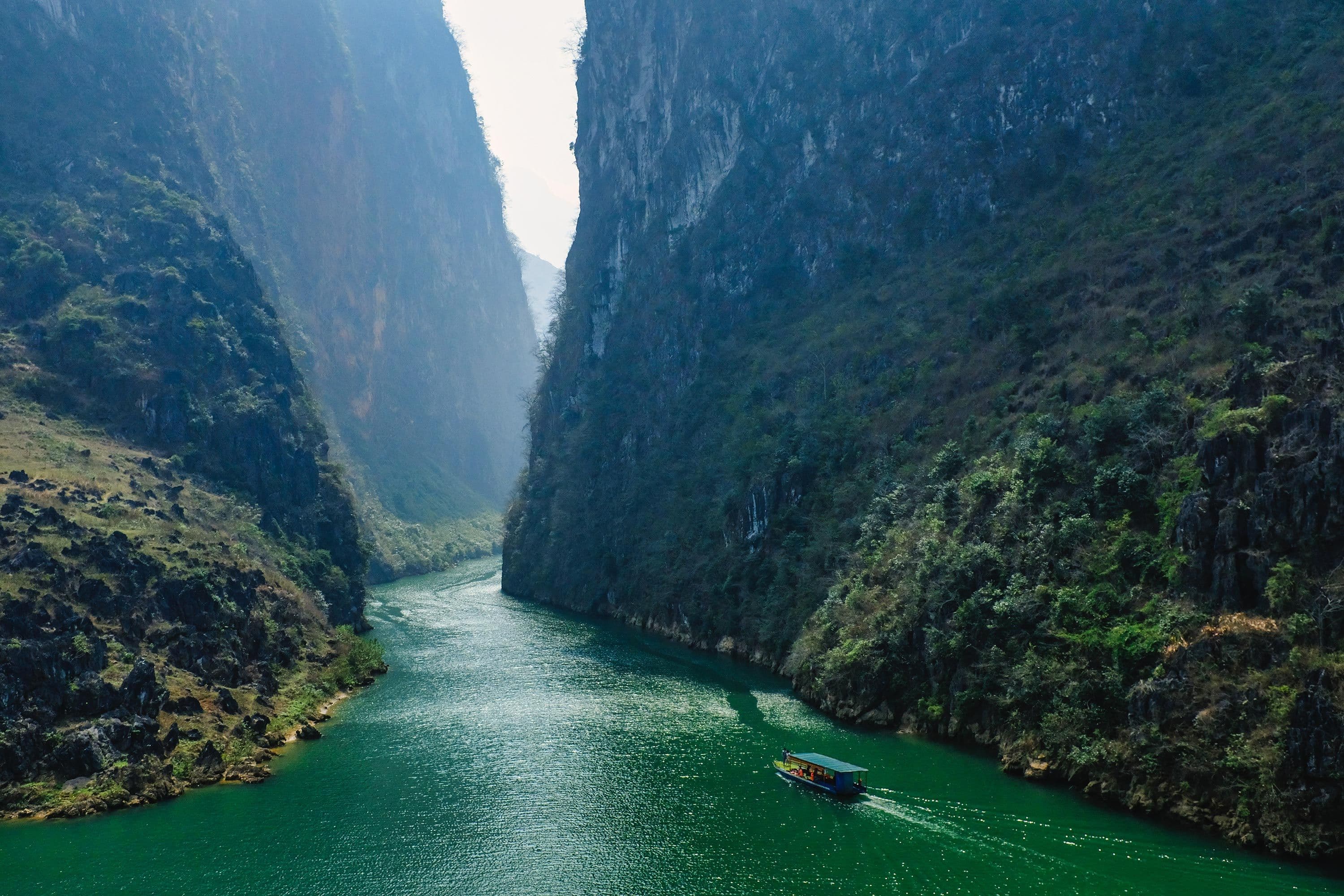
- the headline Dong Van ↔ Meo Vac / Ma Pi Leng segment, which is the visual peak of the route
- at least one slower cultural moment, such as a market morning, homestay dinner, or evening in Dong Van or Meo Vac
- enough buffer that rain, fog, or fatigue does not force rushed or risky decisions
That is why the question is not only “Can you do it in 3 days?” but “Will it actually feel complete?”
The Real Answer: Day Counts Compared
2 Days / 2 Nights: the fastest taste
This is possible, but it is not the full experience. It is more like a rushed introduction, often built around overnight transfer logistics and a very compressed route.
What you get:
- a quick hit of the main scenery
- a sense of the road and scale
- the feeling of having “done Ha Giang once”
What you miss:
- slower mornings
- market timing
- meaningful town stops
- weather flexibility
- the ability to enjoy Ma Pi Leng without watching the clock
This is best for travelers who simply must see the Loop once and accept that it will feel compressed. That conclusion follows from how even official and tour-based route structures expand the Loop beyond two riding days.
3D2N: highlights-first, still intense
This is the most popular short version. It can absolutely work, especially for first-timers joining a small-group or easy-rider format.
What you get:
- the main anchor towns
- the iconic Ma Pi Leng section
- a route that still feels like the real Loop
What you sacrifice:
- comfort buffer
- flexible stop timing
- longer market or village pauses
- room for bad weather
- the chance to let the route breathe
Bong Backpacker Hostel’s 3-day vs 4-day comparison says the 3-day version covers about 320–350 km, feels fast-paced, and usually includes fewer stops than the 4-day version.
This is best for:
- first-timers with limited time
- travelers okay with long days
- people who want the headline scenery more than slow travel
4D3N: the best full-experience baseline
This is the strongest default answer for most travelers.
Why it works:
- it matches the classic 4-day road-trip logic from Vietnam Tourism
- it gives the route a proper rhythm: gateway day, geopark day, hero pass day, return day
- it adds breathing room for weather, fatigue, and cultural stops
- it makes the Dong Van–Meo Vac segment feel protected instead of squeezed
Distance-wise, reputable route breakdowns commonly place the 4-day Loop around 350–400 km, depending on side trips and exact return shape.
This is best for:
- most travelers
- photographers
- travelers who want scenery plus culture
- first-timers who do not want the trip to feel like a sprint
5D4N to 6D5N: full experience plus hidden gems
This is where the Loop starts to feel truly spacious.
What you gain:
- slower mornings
- more time for markets and village life
- optional stops like Du Gia, waterfalls, caves, or extra viewpoints
- less daily fatigue
- more freedom to let weather shape the route instead of fight it
Recent route comparisons note that the 4-day version often highlights the 3-day skips, such as Lung Cu, Nho Que River, extra villages, and slower cultural stops. Stretching to 5 days or more builds even more of that flexibility in.
This is best for:
- photographers
- culture-first travelers
- slow travelers
- anyone who hates tour-style rushing
Plug-and-Play Itinerary Templates
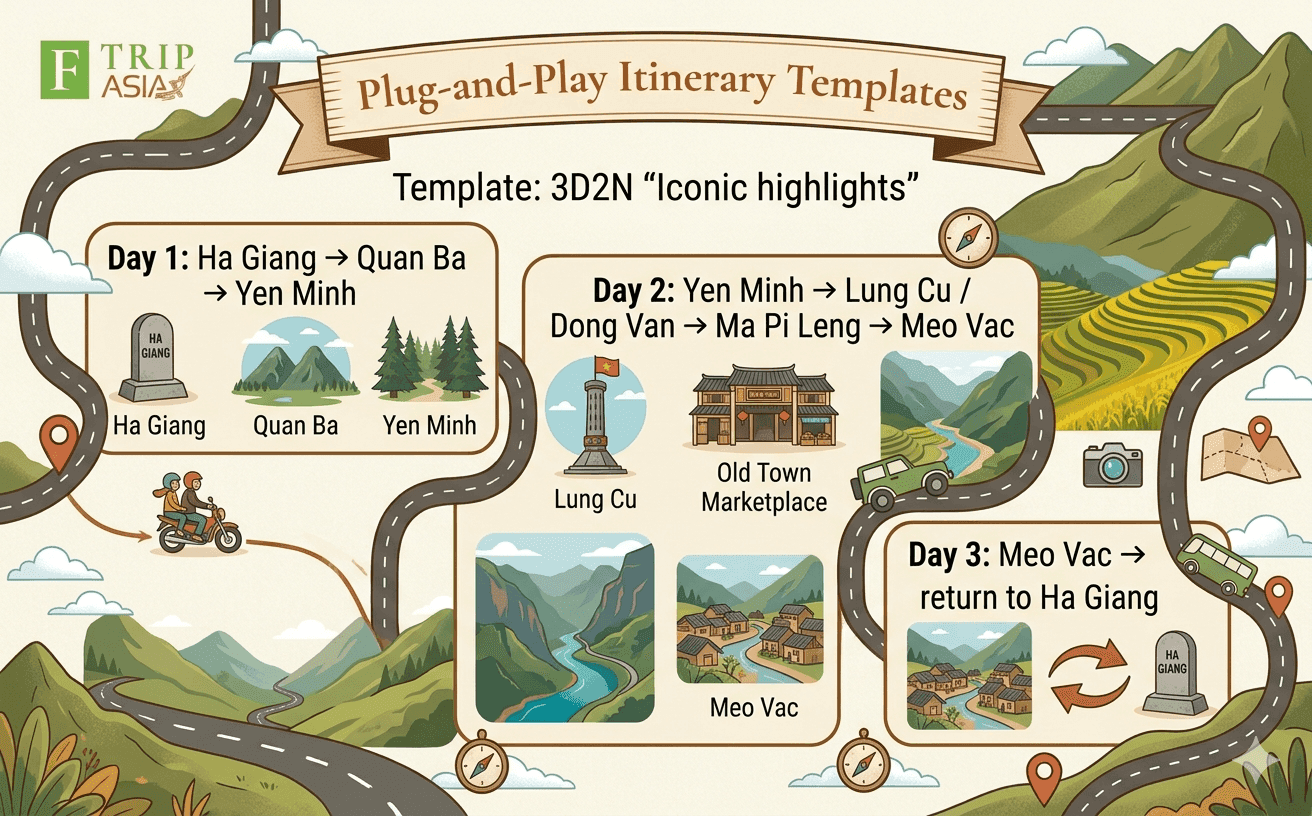
Template: 3D2N “Iconic highlights”
Day 1: Ha Giang → Quan Ba → Yen Minh
Day 2: Yen Minh → Lung Cu / Dong Van → Ma Pi Leng → Meo Vac
Day 3: Meo Vac → return to Ha Giang
This is the compressed but still recognizable Loop. It works because it keeps the core structure intact, but it does so at a fast pace.
Template: 4D3N “Classic loop logic” (recommended)
Day 1: Ha Giang City → Yen Minh
Day 2: Yen Minh → Dong Van
Day 3: Dong Van → Meo Vac
Day 4: Return toward Ha Giang City
This is the cleanest version because it matches the official classic road-trip logic: QL4C out, QL34 back.
Template: 5D4N “Full experience + breathing room”
Use the 4D3N template, then add:
- one slower cultural morning such as a market or town walk
- one extra day for Du Gia, a waterfall, cave, or quieter village stop
This is where Ha Giang feels less like an itinerary and more like a journey.
The 5 Factors That Decide How Many Days You Need
1. Travel style
If you are an easy rider or car, you may be able to handle 3D2N more comfortably than if you self-ride. Self-riding usually benefits from more rest buffers because fatigue matters more.
2. Photography goals
If you care about sunrise, golden hour, fog layers, or clean viewpoint timing, you need more flexibility. That usually means 4 days minimum, ideally more.
3. Weather tolerance
Mountain fog and rain can change the plan quickly. Buffer days reduce stress and make safer decisions easier. That is one of the strongest reasons to avoid over-compressing the route.
4. Culture priority
If you want markets, village life, and homestays to feel meaningful, 3D2N is usually too tight. A longer route lets these experiences fit naturally instead of feeling like interruptions.
5. Comfort level
This is the biggest one. 3D2N is doable. 4D3N is where it starts to feel complete. 5–6 days is where it starts to feel genuinely relaxed.
FAQs
Is 3D2N enough for the Ha Giang Loop?
Yes, for the highlights. No, if by “enough” you mean a full, relaxed experience with cultural time and weather flexibility.
Why do many people recommend 4 days for the Ha Giang Loop?
The classic route is officially structured as a four-day road trip, and that extra day gives better pacing for the main scenery, especially Ma Pi Leng, while reducing fatigue and rush.
How long is the Ha Giang Loop in a typical 4D3N plan?
Common route guides place it around 350–400 km, depending on side trips and exact overnight structure.
What makes the Dong Van Karst Plateau area so special?
It is part of the Dong Van Karst Plateau UNESCO Global Geopark, recognized for its extraordinary limestone landscapes and geological significance.
What do you gain by adding a 5th day?
Usually more village and market time, optional Du Gia or waterfall stops, slower mornings, and more freedom to adapt to weather.
Conclusion
If you want the Ha Giang Loop to feel like the full experience, plan 4D3N as your baseline. That is the point where the trip usually stops feeling like a rushed checklist and starts feeling like a proper mountain journey. It matches the classic route logic, protects the Dong Van–Meo Vac / Ma Pi Leng highlight day, and gives you enough room for scenery, culture, and better decisions on the road.
Choose 3D2N only if time is tight and you are comfortable with intensity. Choose 5–6 days if you want the version of Ha Giang that includes markets, villages, slower mornings, and real flexibility when mountain weather changes the plan. That is usually the difference between “I completed the Loop” and “I really experienced it.”


Founder & Photography Guide
Specialties: Culture, landscape, portrait, hiking, active and adventurous tour
Besides my unlimited passion for traveling, a professional tour guide for over a decade, I have been taking photographs since sitting at Hanoi of the University of Culture in the early 2000s. Photography started as a hobby but it was seriously taken due to my work relations and my significant passion for the beauty of our world, especially in Southeast Asian parts such as Vietnam, Laos, Cambodia, and Myanmar.
Within a few years of taking photographs, my works began to be recognized by many reliable international publications such as AFAR Travel, The Times, and The Daily Telegraph newspaper. In addition, I continuously add to my growing profile by winning numerous major awards: 3rd Position of The Independent Photographer 2018, 1st Position of Amateur Photographer of the year 2018, Grand Prize Winner of the AFAR Travel Photography 2019, and a Gold Award of San Francisco Bay International Photography 2020.
I photograph a wide variety of subjects, from travel to landscapes to street scenes. I enjoy documenting the East’s rich cultural heritage and its land soaked in glorious sunrise or sunset light in remote and secluded spots. And, I am very happy to share my knowledge and experience with you. You can visit Luminousvietnamtour to explore tour!